
Originally published in the Martinez News-Gazette on 02/17/2019. Holiday Food - Courtesy, The Parent Report Holiday Food - Courtesy, The Parent Report Picking up Aaron’s story from where we left off, William Rice still had custody of Nathaniel while the rest of his family was free. They finally get to celebrate the holidays without following someone else’s rules. This included their first ever Thanksgiving as it was not recognized in the South while Christmas was actually illegal in the North and wasn’t a federal holiday until 1870. When William Russell sells his Napa property to Robert and Charlotte for $100 ($3,000 today) on September 19, 1860, it established the family’s livelihood for years to come. For the Rice family to keep the land, under the Preemption Act of 1841, they had to cultivate crops or build a home. The 1853 U.S. California Survey Act allowed only improved property to be sold or purchased with few exceptions, which makes the Rice family’s acquisition even more impressive.  1890 Photo of Original Todd Flag, Courtesy Public Domain 1890 Photo of Original Todd Flag, Courtesy Public Domain With the Civil War fast approaching, they become both observers and participants of one of the most consequential periods of California and US History. President Lincoln’s election on November 6, creates great tension within the state and anxiety for African-Americans. Approximately twenty percent were Southern sympathizers, with large numbers in Monterey, Napa, San Francisco, San Joaquin, Santa Clara and Tulare Counties along with the majority of Southern Californians, who supported and attempted secession. On April 12, 1861, the Civil War officially begins and by September 4, California elects its first Republican Governor, Leland Stanford. The state goes on to bankroll the Union’s cause while remaining unified. 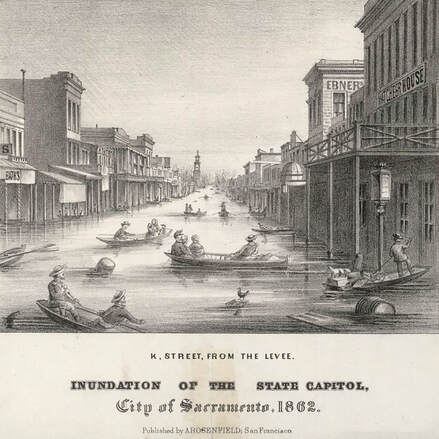 Courtesy Public Domain Courtesy Public Domain The Great Flood of 1862 brings about enormous destruction and loss of life in California, Oregon, Nevada, Idaho and more. Despite certain damage to their family farm, they survive and continue to be prosperous. However, that April Louis (their youngest son who was only 11 years and 8 months old) dies of consumption (TB). On September 22, the Emancipation Proclamation is issued, declaring an end to slavery, if the Confederacy doesn’t surrender by January 1, 1863. 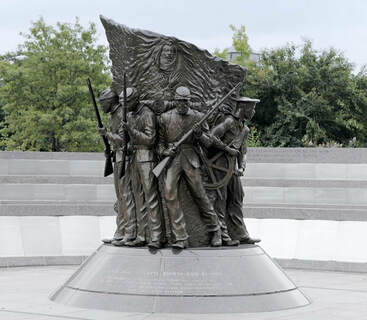 "The Spirit of Freedom" - Washington D.C. "The Spirit of Freedom" - Washington D.C. On May 22, 1863, the War Department issues General Order No. 143 establishing the “U.S. Colored Troops.” Then in short order: April 9, 1865, Robert E Lee surrenders; April 15, President Lincoln’s assassination; May 9, Civil War ends and finally June 19, slavery officially ends. Today, forty-five states celebrate “Juneteenth” or “Freedom Day” as a holiday yet it’s not recognized nationally. During this turbulent time, African-Americans sought safe places to fulfill their social, spiritual, educational and political needs. For most of the Napa African-American community, membership in the integrated Methodist Episcopal Church (ME) was one. Yet despite the anti-slavery congregation, cultural differences made it difficult for them to discuss politics and education. Edward Hatton’s Napa barbershop was another. He and his son Joseph were agents for both San Francisco African-American newspapers the Pacific Appeal founded 1862 and The Elevator founded 1865, vital components of their budding society. 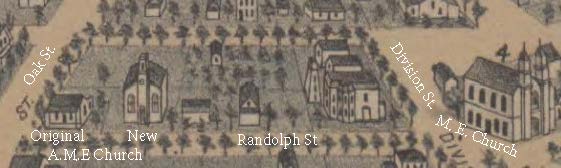 Birds Eye View of Napa City 188? - Courtesy Bancroft Library UC Berkeley In April 1867, the newly formed African-American Methodist Episcopal (AME) Church of Napa purchases the old ME’s building with Aaron, Nathaniel, and five others as trustees. On October 2, they acquire property to house it. (Our first proof that Nathaniel reunited with his family.) Aaron’s father Robert, without any formal training, often officiated while Nathaniel ran the Sunday school. Since public schools didn’t exist until late 1870’s, the AME Church became Napa’s only African-American school. 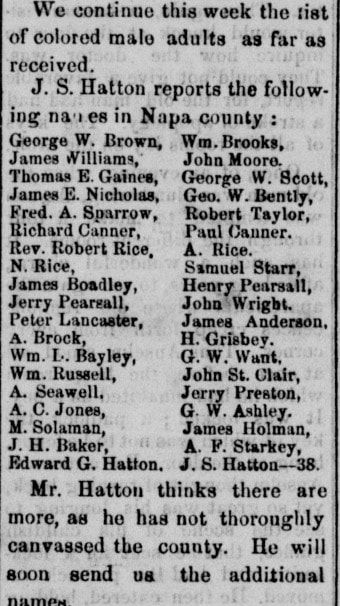 The Elevator November 26, 1869, Courtesy Public Domain The Elevator November 26, 1869, Courtesy Public Domain After three years of struggle, the 14th Amendment granting citizenship to African-Americans is ratified on July 9, 1868. However, without voter protections, full citizenship remained elusive. Thus on February 26, 1869, the 15th Amendment is drafted, securing voting rights for all citizens. To pressure the California Legislature for ratification, both The Elevator and Pacific Appeal sponsored preregistration efforts of African-Americans. The November 26, 1869, issue of The Elevator, publishes Joseph Hatton’s list of prospective voters naming Aaron, Nathaniel, his father Rev. Robert Rice, and 35 others. By February 3, 1870, the Amendment is ratified causing widespread celebration. (However, it takes the civil rights movement of the 50s and 60s for California to finally ratify the 14th Amendment in 1959 and the 15th Amendment in 1962.) Aaron registers for the first time on April 16, 1870 along with Robert and Nathaniel. Until their deaths, they never missed an opportunity to vote.  1870 US Census, Courtesy Public Domain 1870 US Census, Courtesy Public Domain The 1870 Census depicts the Rice family living together in their newly built farmhouse with Robert 70 as head of household, Dilcy 74, Aaron 49, Charlotte 58, Nathaniel 24 with Robert owning the property valued at $1,000 ($20,000 today) and a personal of $600 ($12,000 today), while Nathaniel’s personal estate is $200 ($4,000 today). However, Aaron has no wealth recorded despite purchasing two thirds of the property from Robert for $1 in 1869. Additionally, Robert, Dilcy and Aaron’s recorded origin of birth is N Carolina, Charlotte’s Virginia, Nathaniel’s Missouri, and Robert’s parents as foreign-born (Africa). It also recorded Aaron and Charlotte as illiterate, Robert and Dilcy as readers only, and Nathaniel as literate.  1869 Napa Map, Courtesy Public Domain 1869 Napa Map, Courtesy Public Domain From the historical record, we can imagine a day in the life of Aaron’s Family. Aaron and Nathaniel did most of the wheat harvesting and preparation of its milling. On a good day, they would haul the grain by wagon, traveling the dirt roads back into town to leave it with the W. R. Cooper’s Flour Mill. They would continue on to Main Street probably stopping at J. B. Murphy’s Candy Factory and Bakery to satisfy their sweet tooth or checking on Charlotte or Dilcy’s baked goods before visiting friends, the Hatton’s at their barbershop. If they needed horse equipment or repairs, next door was Beebe & Hall. Along their journey, they might have observed the Amelia a 174-foot steamboat or the Napa Valley Railroad transporting passengers and goods to and from Napa. After enough time passed, they would return to the mill for their flour to sell it or keep it for Charlotte and Dilcy to bake more goods for the market or Sunday church socials. With Nathanial being of marrying age, it was only a matter of time…. Judie & Joseph Palmer are two of the founding members of the Martinez Cemetery Preservation Alliance and the Potter’s Field Project. Both have a passion for discovery, history, genealogy, anthropology and archaeology. For more info, please visit our website MartinezCemetery.org. To learn more regarding our sources and detail about Aaron’s life, type Aaron Rice in the Search Bar. Do you have a Potter’s Field story to tell? We welcome any pictures or information regarding the Alhambra Cemetery’s Potter’s Field. Please email us at martinezcemetery@gmail.com or call us at (925) 316-6069.
Originally published in the Martinez News-Gazette on 02/17/2019.We apologize for not writing since last May, but circumstances arose that put our column on hold. In celebration of Black History Month, we wanted to complete Aaron Rice’s story. However due to the time gap, we thought it best to summarize his saga in a few installments before finishing his story with the last. For new readers, we welcome you. For our devoted fans, we thank you for your patience. With that let’s begin…  Caswell County, NC Caswell County, NC Aaron Rice was born enslaved on January, 1819, Caswell County, North Carolina to his mother Dilcy and father Robert Rice. They were the property of Archibald and Sally Jane Rice, who at the time owned a cotton farm. To piece together Aaron’s story prior to 1860, we had to rely on oral histories and infer from other documentation related to their owners because there was no census data and very little records kept on the enslaved until after slavery was abolished. 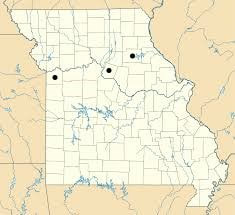 MIssouri, (Rice homes dotted) MIssouri, (Rice homes dotted) From a number of sources we know that the Rices moved from N Carolina to Missouri in October 1826. For the next 10 years, they relocated several times before finally settling on 160 acres in Raytown, 8 miles from Independence on the Santa Fe Trail, when Aaron was 17. By 1838, they had cleared the land, built their home and established crops of corn and wheat. By 1844, they replaced their two-story log cabin with a gothic-style farmhouse that is still standing today.  Courtesy Friends of Rice-Tremonti Home Association Courtesy Friends of Rice-Tremonti Home Association For those of you familiar with the popular 1985 computer game “The Oregon Trail”, the starting point could easily have been represented by the “5 star rated” Rice farm. It offered travelers bound for Santa Fe and California, space for wagons, springs for watering, and grazing fields for feeding animals. Numerous accounts speak favorably of the Rice’s hospitality with Aaron most likely taking care of their animals and livestock. During 1849 alone about 490 men and 132 wagons lingered at the Rice campground. On February 26, 1840, the Rice’s son William marries Louisa Ish, a native of La Fayette County, Missouri, and moves about five miles outside of Independence. As was custom to give slaves as wedding presents, we believe this is how Aaron and his family became William’s property. 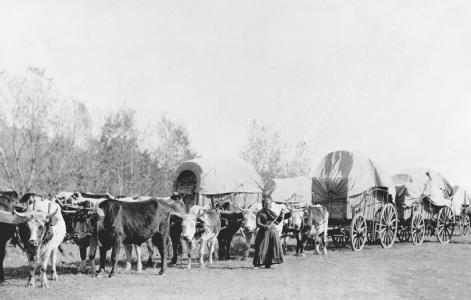 The Oregon Trail Courtesy Public Domain The Oregon Trail Courtesy Public Domain Because of William and his family’s involvement in the violent, bloody events of Missouri and Kansas, they choose to flee in order to avoid prosecution. From his own account, William leaves on April 28, 1859 for California with his wife and children, 890 head of cattle, 6 wagons, 24 oxen, an ambulance, 30 head of horses and mules, 17 hired men and 6 Negroes. From other records, we know this to be Aaron, his parents Robert and Dilcy, wife Charlotte, sons Nathaniel (born 1846) and Lewis (born 1850). William’s family on the other hand fled to Texas taking with them Aaron’s brother William and his family and perhaps their sister (although she disappears leaving her fate unknown). Again, for anyone who played “The Oregon Trail” you have an idea of what the approximate 3,000-mile harrowing journey was like for the Rice families. There were losses of livestock due to theft and death, losses of equipment due to damage, bouts of Cholera, and more. When they finally reached the Sacramento Valley, William had only four wagons left, the family coach, some cattle and a man or two.  Courtesy Library of Congress Courtesy Library of Congress It was late 1859 when they finally arrived in Napa. William rents land from former Missouri Gov. Lilburn Boggs who dies soon after on March 19, 1860. His widow sells William (who departs soon after with Aaron’s son Nathanial to establish his ranch in Walnut Creek) the land along with at least three other slaves whom (with Aaron and the rest of his family) are left in her custody to work his farm. In April, the highly influential and powerful abolitionist Rev. Thomas Starr-King visits Aaron and the others working the farm. There we believe he apprises them of their rights and freedom, as California is a free state. However, the California Fugitive Slave law of 1852 left African-Americans in limbo as they were considered neither slave nor citizen. Aaron and his family chose to stay while the rest left immediately. We believe Aaron’s family stayed behind to regain custody of Nathaniel, prevent the law from being applied against them, and finally receive payment for services rendered from William. The US Census from July 12 lists William 46, living in Napa City in Napa County, farmer, with a personal estate of $14,225 and Aaron’s son Nathaniel 14 as a servant. Meanwhile on July 23, Aaron and his family are enumerated for the first time. The Census lists Aaron 45, day laborer; his wife Charlotte 48, servant; and their son Louis 12, (actually 10) all living in Napa with no personal wealth noted. However, Aaron’s parents Robert and Dilcy remained unrecorded. 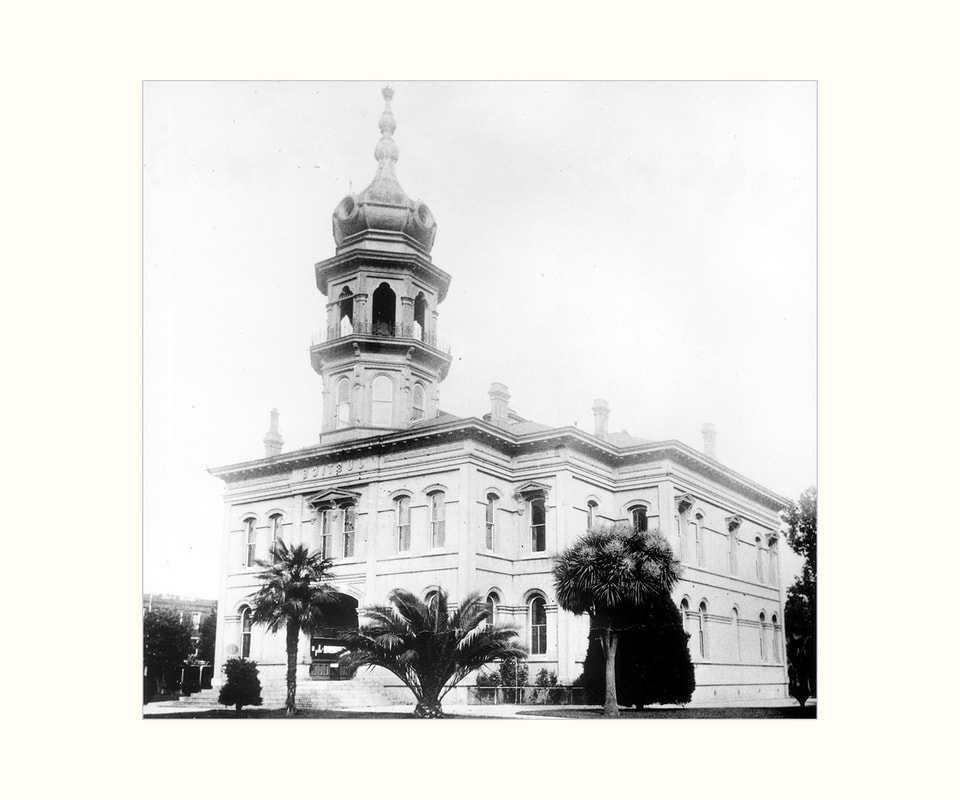 Napa County Courthouse 1879, Courtesy Public Domain Napa County Courthouse 1879, Courtesy Public Domain Unfortunately, William refuses to release Nathaniel. On August 12, believing his family was done with their bondage contracts, Aaron finds the courage to press charges against William (despite the odds stacked against him) risking his own potential imprisonment. Until 1873, state law considered African-Americans inferior to Whites, thereby preventing Aaron from testifying. As a result on August 20, he losses and is jailed for (ironically) perjury. Fortunately, his friends exchanged their labor as payment for his $500 bail ($15,000 today) thereby limiting his confinement to overnight. His case becomes well known, as he was one of only four former slaves to ever sue their former master in the great state of California. How long Nathaniel was forced to stay under William’s custody is unknown. However, a month later on September 17, 1860, Charlotte and Robert buy a 160-acre farm for $100 ($3,000 today) from William Russell. Probably Aaron was excluded from the deed due to his newly acquired record. Despite limited opportunities available to them, Aaron’s family quickly earned the ability to purchase property, forging a new and exciting chapter for themselves…. Judie & Joseph Palmer are two of the founding members of the Martinez Cemetery Preservation Alliance and the Potter’s Field Project. Both have a passion for discovery, history, genealogy, anthropology and archaeology. For more info, please visit our website MartinezCemetery.org. To learn more regarding our sources and detail about Aaron’s life, type Aaron Rice in the Search Bar. Do you have a Potter’s Field story to tell? We welcome any pictures or information regarding the Alhambra Cemetery’s Potter’s Field. Please email us at martinezcemetery@gmail.com or call us at (925) 316-6069.
This is an update of our 03/11/2018 Column on the potential finding of the original 1856 ME Church of Napa with some revisions. It was originally published in the Martinez News-Gazette on 06/03/2018.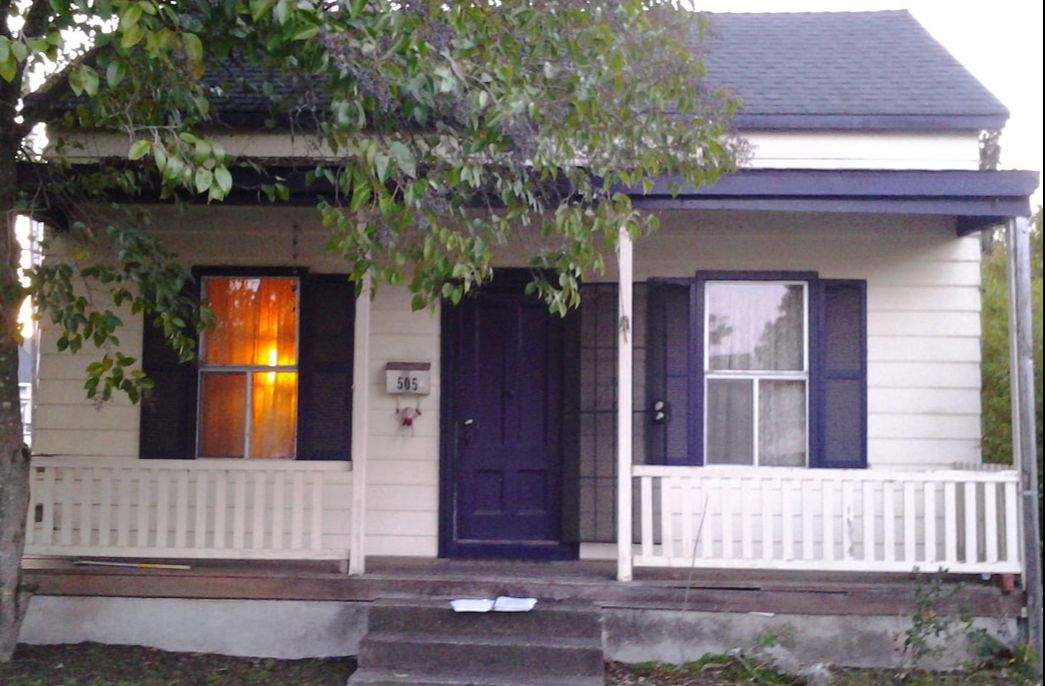 Since we last wrote about the potential finding of the lost African Methodist Episcopal (AME) Church of Napa from 1867 – 1892, a lot of new information has come to light creating a number of unresolved questions regarding the building, its exact location, and wither it survived. As Aaron Rice and his family were instrumental in establishing the church, we felt it necessary to attempt to answer them. 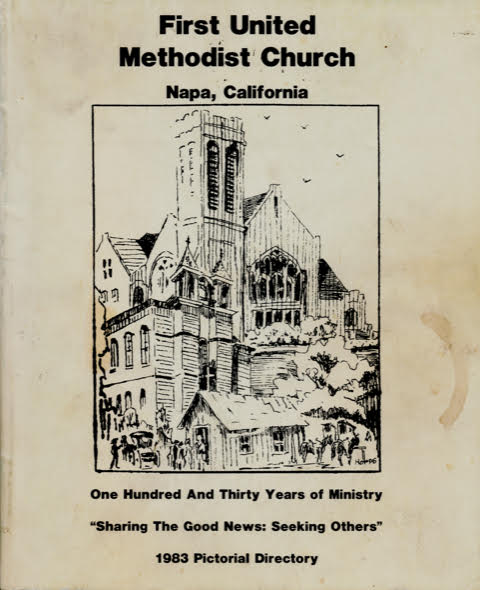 1983 Pictorial Directory - Courtesy Mary Herzog 1983 Pictorial Directory - Courtesy Mary Herzog Let’s start at the beginning, from Mary Herzog’s (Napa Methodist’s Church Historian) research, J.E. Pond and his wife Amanda were pioneers of Napa and founding members of the Methodist Episcopal (ME) Church. From 1856–1860, Mr. Pond purchased Lots 1-4 in Block 19 of Napa Abajo. In 1867, the African-American community bought the 1857 church building for $600 from their white brethren of the ME Church and moved it one block onto Washington (now Randolph). (As a side note, we discovered that in the mid to late 1800’s it was commonplace in Napa (like Martinez) for buildings to be relocated. In a number of cases they were just repositioned.) 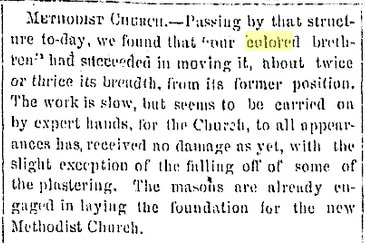 Napa Valley Register, May 4, 1867 - Courtesy Public Domain Napa Valley Register, May 4, 1867 - Courtesy Public Domain On May 4, 1867, from an article published in the Daily Evening Reporter, “Passing by that structure to-day, we found that “our colored brethren” had succeeded in moving it, about twice or thrice its breadth, from its former position. …The masons are already engaged in the foundation for the new Methodist Church.” Mary recalled a story she had heard years ago, “… about the church being moved out into the street and used for worship while the new church was being built. At the time I understood they were talking about 1916 when the 1867 church was being replaced by the present church. It really didn’t make sense that such a large church could be moved and that it would be allowed to block streets in a built up area.” 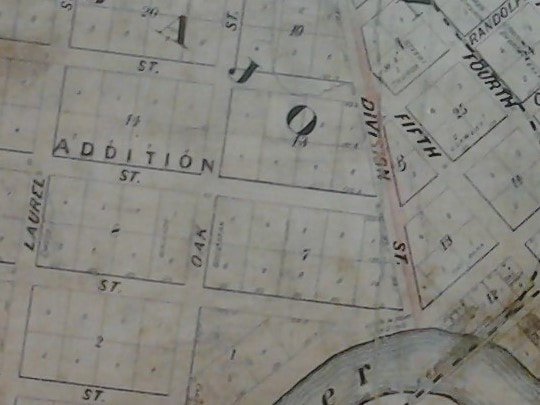 1869 Napa Map - Courtesy Public Domain 1869 Napa Map - Courtesy Public Domain She found a number of mentions about the AME’s fundraising efforts published in the local paper, including one festival that raised $86. “It makes sense that they were still in the process of trying to purchase a permanent lot and that it took several months to accomplish that.” On October 2, 1867, the AME Trustees did purchase the “Northern half of Lot number four (4) in Block number nineteen (19) in the Town of Napa,” (next to the corner of Oak and Washington) from Mr. Pond for $250. She also found that on November 9, 1869, Mr. Pond sold the “Southern half of Lot number (4) in Block number nineteen (19) in the Town of Napa” to Joseph and Penelope Howell. Although the 1870 census didn’t record street names, she recognized “several families surrounding the Howell family as those living between Washington and the river.” 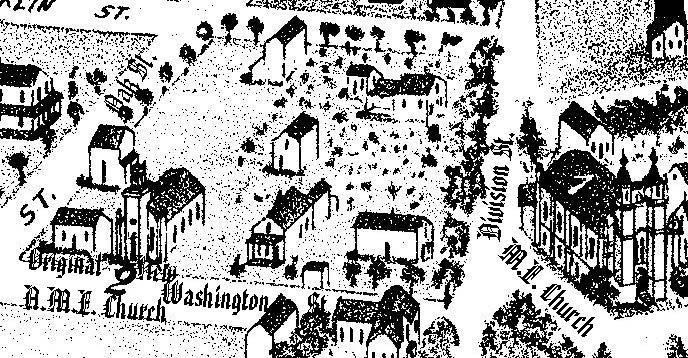 Birds Eye View of Napa City 1871 - Courtesy P.F.R.P. From the 1880 census the Howells are recorded as living on Oak St. However from an 1871 “Bird’s Eye View” map of Napa, it illustrates a large church structure labeled the “Colored M.E. Church” next to a building we believe was the original ME church facing Washington not Oak. Another “Bird’s Eye View” map produced in 188? by the same publisher utilizing a different illustrator, depicts the same two buildings with the corner structure now having porches and side windows. 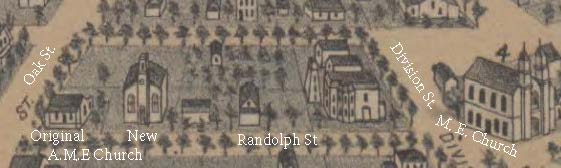 Birds Eye View of Napa City 188? - Courtesy Bancroft Library UC Berkeley In 1881, the History of Napa and Lake Counties, printed and published by Slocum, Bowen & Co., regarding the AME Church states, “Now the building is the abode of bats and mice, being entirely dilapidated,” implying the church is unsafe and potentially abandoned. 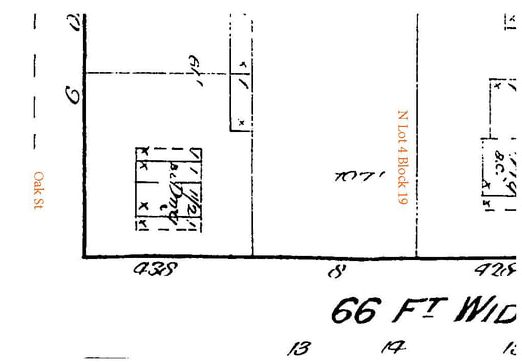 Sanborn Map 1891 - Courtesy Public Domain Sanborn Map 1891 - Courtesy Public Domain Mary also found that in 1882, the Howells sold the South half of Lot 4 to James McWilliams. From other records we discovered his ownership of a number of properties throughout Napa County. If the church was unsafe as of 1881, where did the AME parishioners worship? The trustees as we know didn’t sell the land until May 9, 1893 and from the 1891 Sanborn map the larger building is gone. According to Alexandria Brown (Napa Historian), by the 1880’s there had been a large exodus of the African-American community from Napa. Interestingly enough, a month after the AME trustees sell their property in 1893 to HH Briggs for $700, he moves into the corner house. There is no record of anyone living there after 1882 before Mr. Briggs moves in, indicating that it could have indeed been rented by the church from Mr. McWilliams. 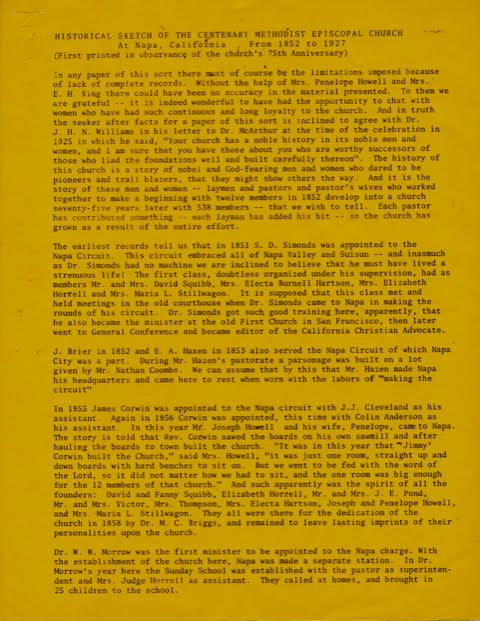 Historical Sketch of the Centenary ME Church 1852-1927 - Courtesy Mary Herzog Historical Sketch of the Centenary ME Church 1852-1927 - Courtesy Mary Herzog From the Historical Sketch of the Centenary Methodist Episcopal Church 1852-1927 published 1927, parishioner Mrs. Penelope Howell stated to Ruth Norton, “It was just one room, straight up and down boards with hard benches to sit on. But, we went to be fed with the word of the Lord, so it did not matter how we had to sit, and the one room was big enough for the 12 members of that church.” Her depiction matches the corner house, not the larger building next it. According to Mary, “Mrs. Howell was 100 years old at the time and had been one of the founding members of the church along with Mr. & Mrs. J. E. Pond. She died at age 101, in January of 1929,” therefor making her account less reliable. However, we feel the opposite since not only was Penelope a founder but she had lived in or next to the church for twelve years. 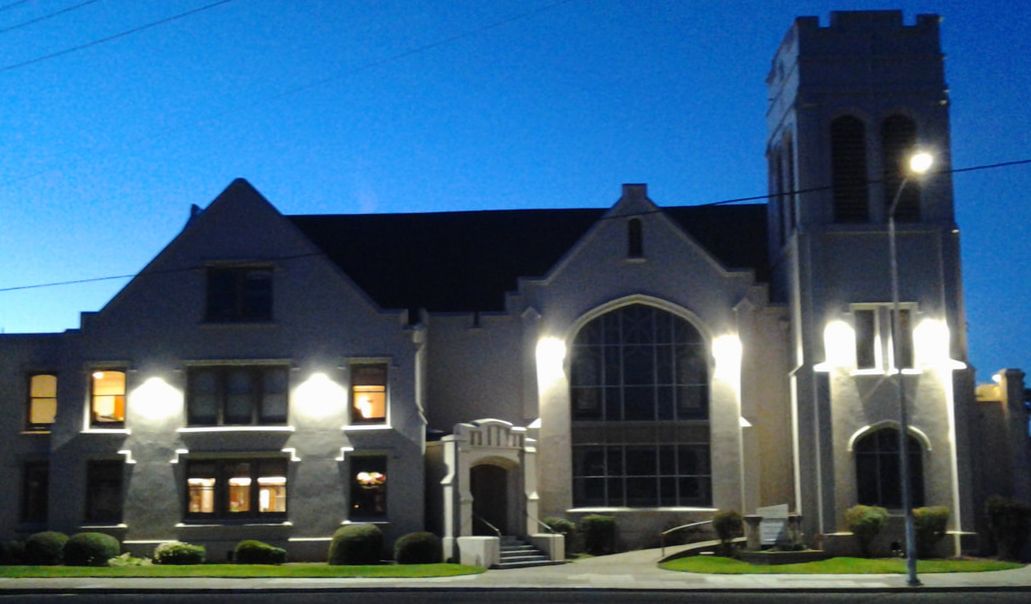 Methodist Church March 5, 2018 - Courtesy PFRP Methodist Church March 5, 2018 - Courtesy PFRP When we spoke to Kenneth Fish, the current resident, he recounted the story told to him from the previous owners, that the house was moved from the location of the Methodist Church in 1866. When we were doing our research of Napa County records, an assessor who had lived in that neighborhood recalled the same story. He went on to give us an original recorded account of the house as being nothing more than a 24’ x 24’ room. Mr. Fish concurred by stating that it obviously contained only one room, as at some point it was split in two using very thin material. In addition, the building is consistent with late 1850’s construction.  Potential Original Church Window circa 1856 Potential Original Church Window circa 1856 This leaves our biggest question to answer, if the smaller house is the original church, where did the larger one come from? One potential possibility is the small building was originally moved onto the North half of Lot 4 but the congregation quickly outgrew it and a larger structure was needed. Therefore, they moved it to the Southern half of Lot 4 to make room to build a bigger church. Most likely, they exchanged the building for lumber in a handshake deal very common in Napa dealings. Unfortunately, not being well constructed, it lasted only 12 years as referenced by the Slocum historical account. So far, we have not found any documentation that directly supports this idea yet but it does fit the evidence we have found. However, there are existing tax records of the AME Church currently misplaced (from the 2014 earthquake) that could provide answers. Stay tuned…
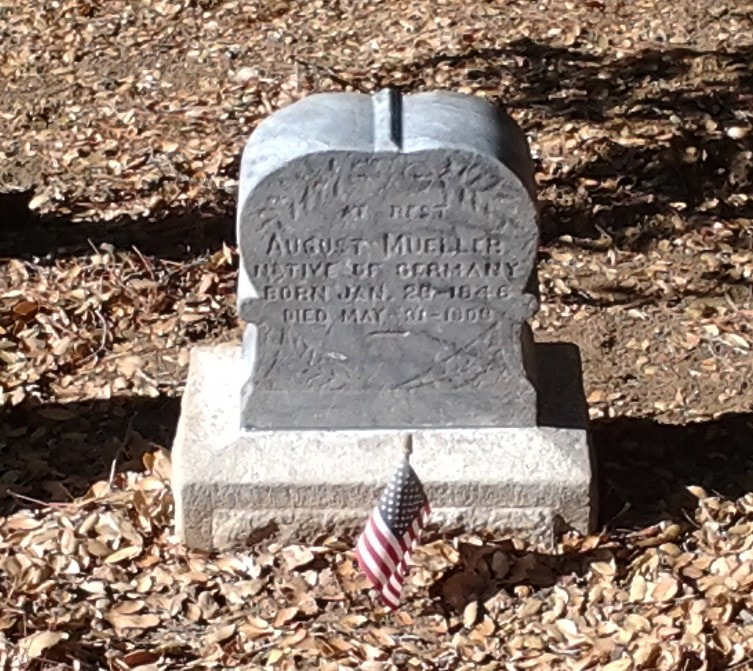
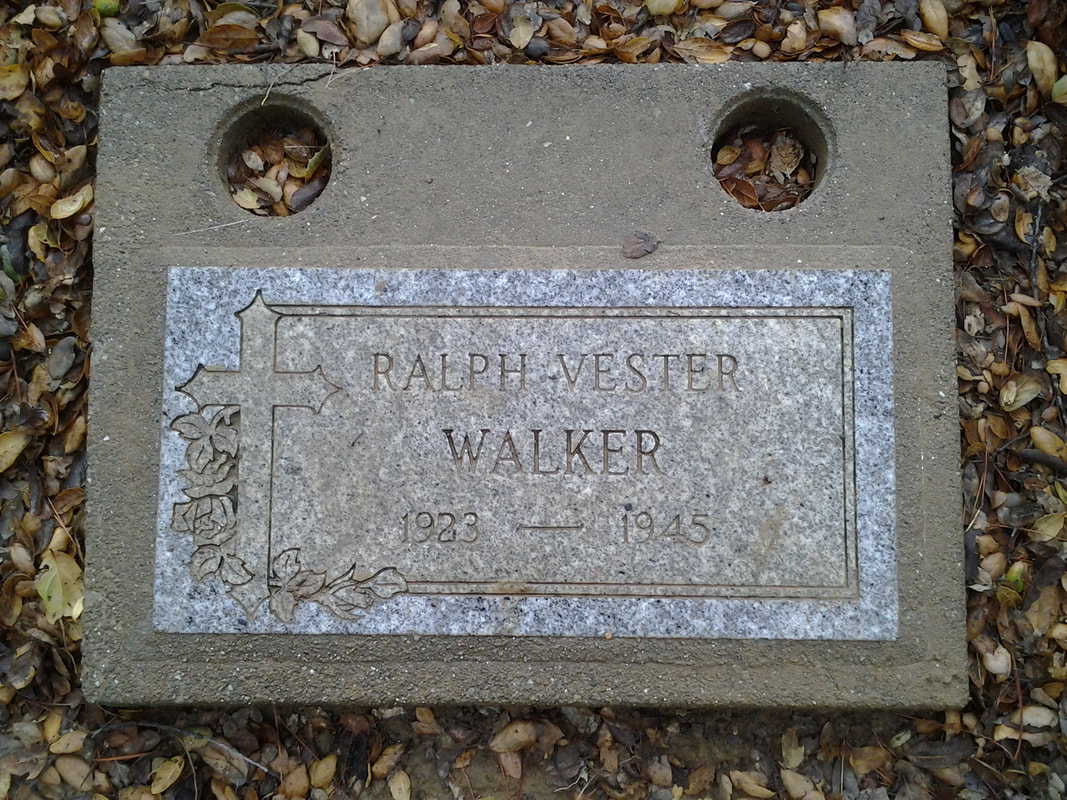
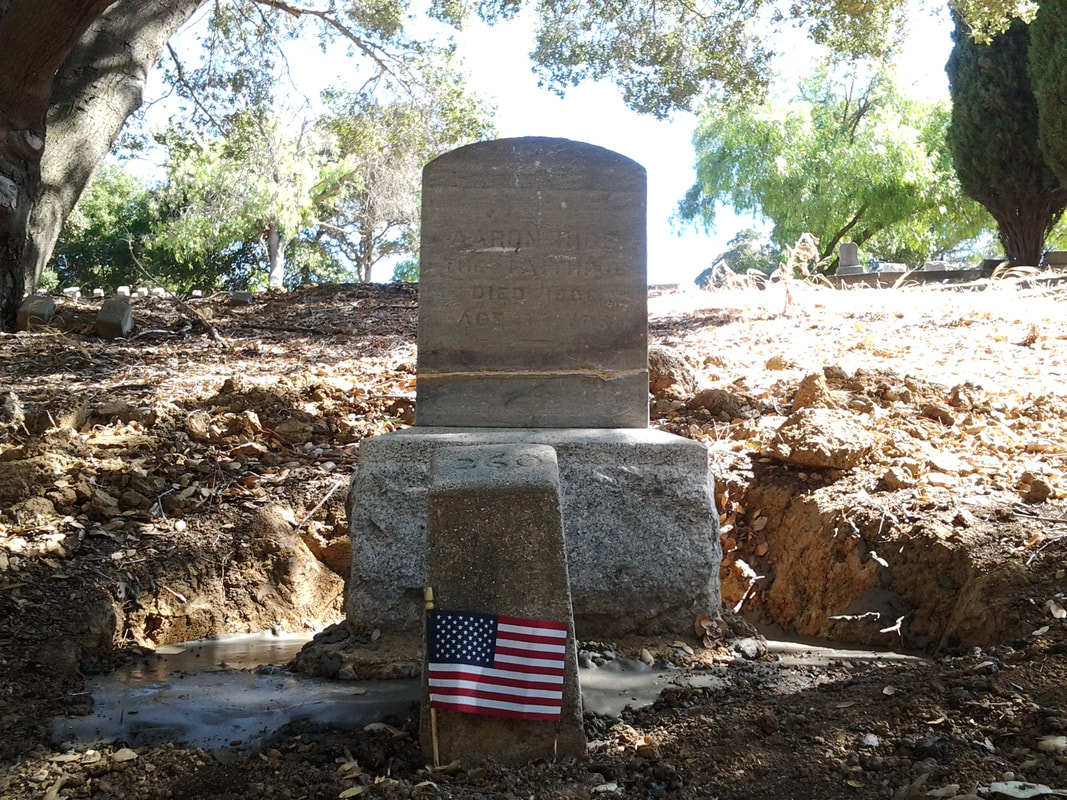
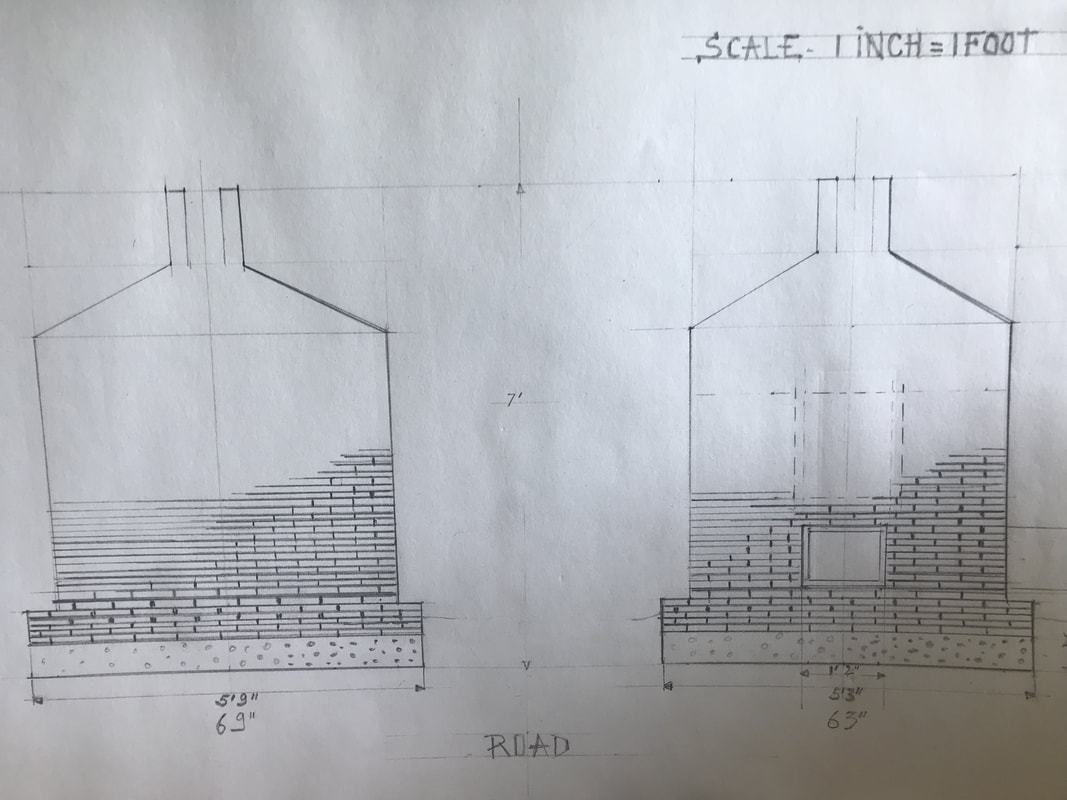
The authors of this column would very much like to thank Mary Herzog, Alexandria Brown, Kenneth Fish, Presley Hubschmitt, Nancy Levenberg, John Tuteur and his amazing staff for their generous support, help with our research and collaboration. Judie & Joseph Palmer are two of the founding members of the Martinez Cemetery Preservation Alliance (MCPA) and the Potter’s Field Project. Both have a passion for discovery, history, genealogy, anthropology and archaeology. For more info, please visit our website MartinezCemetery.org. Do you have a Potter’s Field story to tell? We welcome any pictures or information regarding the Alhambra Pioneer Cemetery or its Potter’s Field. Please email us at martinezcemetery@gmail.com or call us at (925) 316-6069. This article was published in the Martinez News-Gazette on 05/20/2018 and is the thirteenth part of our continuing story about Aaron Rice and his family.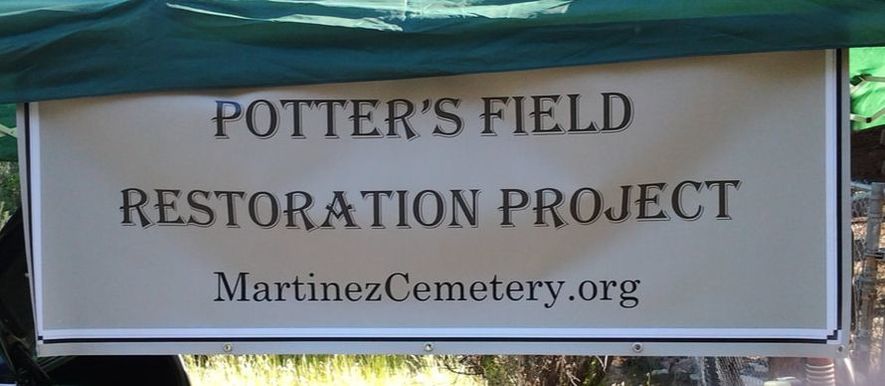 Ordinarily this column would begin where we left off with Aaron Rice’s story; however Saturday May 12, marked the restart of our Potter’s Field Restoration Project (PFRP) during the Alhambra Cemetery Spring Cleanup for 2018. We last wrote about it this past October. In it we discussed our final work day of the year, site preparations for the upcoming rains, and shared our reflections of its birth on May 9, 2015 to cleanup, restore, and preserve the site. Over the course of the project, 70+ enthusiastic volunteers had given generously of their time, knowledge, and physical work, while others worked quietly behind the scenes gathering more recruits by spreading the word through social media. Last year, the headstones of Nikolao Glaros and August Mueller had been removed, repaired and replaced by the Pan Ikarian Brotherhood Association and August Mueller’s descendants. Members of E Clampus Vitus, Chapter 13 discovered the headstone and border of Ralph Vester Walker while also repairing the headstone of Aaron Rice alongside other project volunteers. Measurements for the Chinese Funerary Burner were taken and its brick foundation excavated. During the dormant months of 2017-2018, a subcommittee formed to design the rebirth of the Chinese Funerary Burner and Altar Complex. The design drawings have been presented to all parties involved and hopefully we will break ground later this summer. 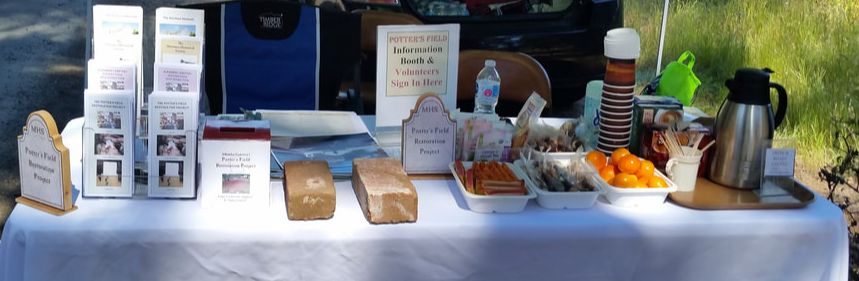 To begin the reboot, volunteers were treated to freshly brewed French Roast coffee, bottled water, packages of nuts, chips, and mandarins. Two volunteers brought extra cinnamon raisin bagels with honey pecan cream cheese to share. Unlike the 2017 Spring Cemetery Cleanup, not much weeding was needed while fallen branches were easily removed by a few of our party. The main task of the morning was to remove the sandbags from the excavated chamber of the burner. While Joseph was removing a sandbag, a little green frog appeared and surprised him. We were very pleased he presented himself as frogs in Chinese culture are a symbol of good luck and new beginnings. After posing for a few pictures, he happily hopped away.  When the removal of sandbags was complete and branches picked up, all gathered to begin the Zen meditative art of cleaning brick. Though this art has been taught often for the past couple of years, the amount of indigenous brick is rapidly coming to an end. Should you wish to learn this art, it is best that you volunteer soon. We may only have a small amount of brick still buried in the silt for future meditations. As the day went on, curiosity got the best of the passersby. While stopping to observe the art of cleaning brick, they were greeted by the new 2’ X 6’ signs reading, “Potter’s Field Restoration Project, MartinezCemetery.org”. Happy volunteers introduced visitors to the project as well as handing out tri-fold brochures. The founders of the PFRP also created a new self-guided tour of Alhambra Cemetery’s Potter’s Field that is sure to please the most ardent of tombstone tourists. It includes the names and brief history of those that have been given a voice in this column. Inside you will find the stories of young and old immigrants who built our community by working for the railroad, shipping, farming, fishing, or building industries. The brochure also includes photographs that can lead you right to the decedent’s gravesite. On project days, artificial flowers and other holiday decorations will be visible at each gravesite for better recognition. Fresh small American flags were placed on a few gravesites. One for Prussian immigrant and veteran August Mueller, who entered the military in 1867 and served as a private for Company K, 12 US Infantry during the Reconstruction Period after the Civil War. Another for 6’ Texas born Ralph Vester Walker member of the U.S. Coast Guard Merchant Marines during World War II who was living in the Bay Area before being killed in a motorcycle accident in 1945. Lastly for Aaron Rice, a former African-American slave who received his freedom in 1860 and along with August finally gained U.S. Citizenship in 1870.
As always are heartfelt thanks go to our many participants, who gave so unselfishly a few hours of their time; Cathy Basen, Richard Blue, Amy Currie, Anneli Loeffler, Shauna Mundt, Chris Rousset, and Tamara Starr. Look for updates in our column as work progresses on the building of the new Chinese Funerary Burner and Altar Complex. Judie & Joseph Palmer are two of the founding members of the Martinez Cemetery Preservation Alliance (MCPA) and the Potter’s Field Project. Both have a passion for discovery, history, genealogy, anthropology and archaeology. For more info, please visit our website MartinezCemetery.org. Do you have a Potter’s Field story to tell? We welcome any pictures or information regarding the Alhambra Pioneer Cemetery or its Potter’s Field. Please email us at martinezcemetery@gmail.com or call us at (925) 316-6069. If you are a history buff or a tombstone tourist, you can find more information and request the self-guided tour brochure by visiting our website MartinezCemetery.org. Every Memorial Day the City of Martinez lays a wreath at the front entrance of the Alhambra Cemetery for all those in the military during the Civil War, World War I and World War II. This got me to thinking about how many military personnel might be buried in the Potter's Field. There is at least 1,000 that are buried there and they were not all poor. Are current research has shown us they might have arrived ill, injured or DOA at the County Hospital due to location or accident. Whatever the circumstances were, we do know that many of them could have been in the military.
This weekend we will be remembering Marine Lt. Col. Benjamin J. Palmer, Joseph's brother, who died in Afghanistan in 2011. We will also be remembering Robert L. Pitt, Judie's father, who died in the line of service saving three of his fellow fireman and succumbing to smoke inhalation in 1964. But we will also remember our Potter's Field neighbors. Six-foot Texan Ralph Vester Walker who was a US Coast Guard Marine during World War II and 5' 5" Carl Ferdinand August Mueller who served as a private, in Company K, 12 US Infantry during the reconstruction period after the American Civil War and received his honorable discharge as sergeant in 1870. We are both looking forward to discovering more of the military presence in Potter's Field in the near future. Our thoughts are with all of you that have lost a loved one during a war or heroic act. And, to those of you who have served our country, we thank you. Joseph and Judie Palmer Co-Founders of Potter's Field Restoration Project Martinez Cemetery Preservation Alliance This article was published in the Martinez News-Gazette on 05/06/2018 and is the thirteenth part of our continuing story about Aaron Rice and his family. Potter's Field, Tulocay Cemetery, Napa CA Potter's Field, Tulocay Cemetery, Napa CA From our last column, we wrote about Aaron’s horrible heartbreak with the loss of his entire family outside of his son Nathaniel in less than a year. It started with the death of his father Rev. Robert Rice (75) on March 20, 1875 from dropsy. Followed by his daughter-in-law Rebecca (21) November 1, 1875 from consumption, mother Dilcy (84) February 16, 1876 from “old age”, and finally with his wife Charlotte (64) on March 3, 1876 from typhoid fever. However, on October 31, 1877 Nathaniel (31) marries Edward Hatton’s stepdaughter Annie Elizabeth Dyer (27) returning much joy back to their lives. We ended our column with a tease regarding Dilcy’s probate. At that time, probate filings had a grace period of four years from date of death to resolve estates where no will was formally filed, or found. Aaron hired attorney Andrew Jackson Hall to file his mother’s probate on January 17, 1880 only after he sold his interest in the 160-acre family farm for $1,000 to Manual Lucas on the same day. Presumably this was to have the money needed to cover the costs associated with his mother’s probate. Fortunately, Aaron did not have to also file a probate for Charlotte, as she no longer had property under her name.  As with any probate, it is a drawn out process that takes some time to complete. A. J. Hall first files Aaron’s “Petition for Letters of Administration” on January 19, 1880, whereupon a hearing is set for February 2 at 10 am. Within his petition, Aaron states that he is the only child of Dilcy’s and her estate is made up of the 1/3 portion of the 160-acre family farm worth a maximum of $150 which garners an annual profit of $20. At the hearing, Superior Court Judge William C. Wallace orders Aaron Rice to become administrator for Dilcy’s estate upon the receipt of a $100 bond, which is issued the same day. His attorney acted as witness along with Thomas M. Brown and Bartolomeo Semorile who signed as guarantors. 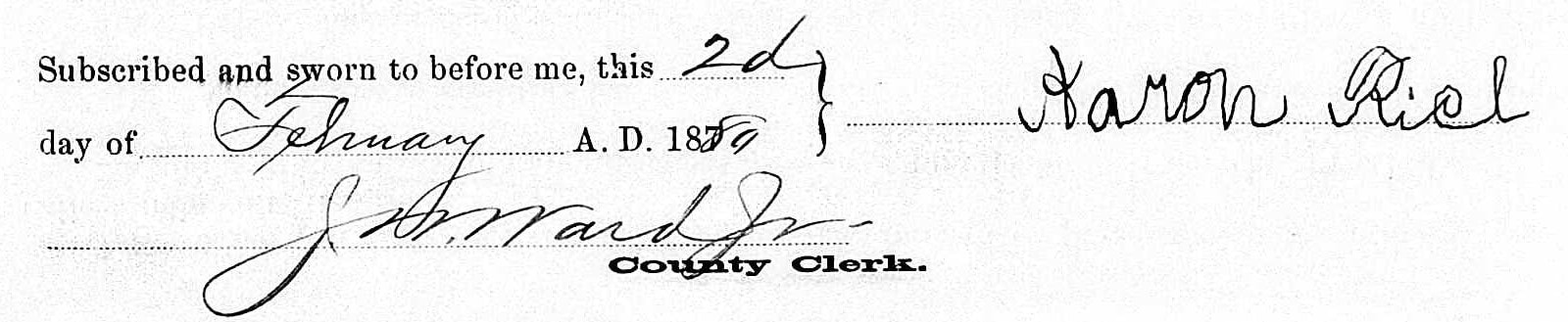 February 2, 1880 - Courtesy Public Domain It should be noted that Aaron, who we know was illiterate prior to these filings, signs his actual name where required. As the proceedings move along his signature vastly improves by the end.  August 4, 1880 - Courtesy Public Domain 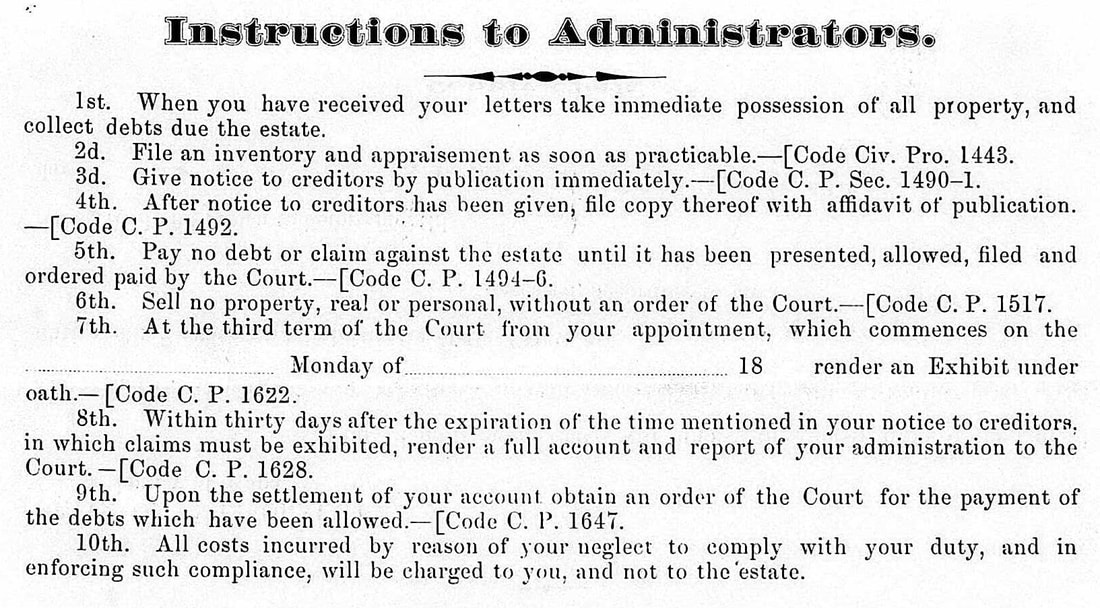 The “Instructions to Administrators” given to Aaron were as follows: “1st. When you have received your letters take immediate possession of all property, and collect debts due to the estate.” “2nd. File an inventory and appraisement as soon as possible.” “3rd. Give notice to creditors by publication immediately.” “4th. After notice to creditors has been given, file copy thereof with affidavit of publication.” “5th. Pay no debt or claim on the estate until it has been presented, allowed, filed and ordered paid by the Court.” “6th. Sell no property, real or personal, without an order of the Court.” “7th. At the third term of the Court from your appointment,… render an Exhibit under oath.” “8th. Within thirty days after the expiration of the time mentioned in your notice to creditors, in which claims must be exhibited, render a full account and report of your administration to the court.” “9th. Upon the settlement of your account obtain an order of the Court for the payment of the debts which have been allowed.” “10th. All costs incurred by reason of your neglect to comply with your duty, and in enforcing such compliance, will be charged to you, and not to the estate.” 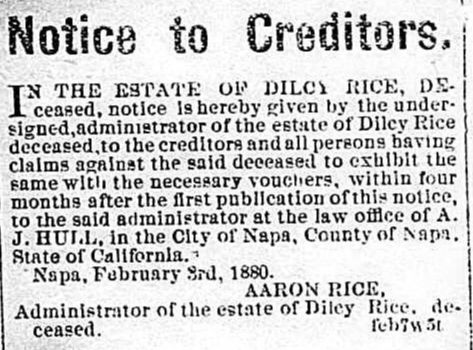 Notice to Creditors, published Napa Register February 7 - March 6, 1880 Notice to Creditors, published Napa Register February 7 - March 6, 1880 On February 3, the “Order Appointing Appraisers” (listing Louis Bruck, Thomas Jefferson DeWoody, and Erwin Samuel Gridley as the appraisers) and the “Order of Publication and Notice to Creditors” (requiring a weekly published newspaper notice for four consecutive weeks) were filed. Creditors were given four months from date of first notice to come forward. 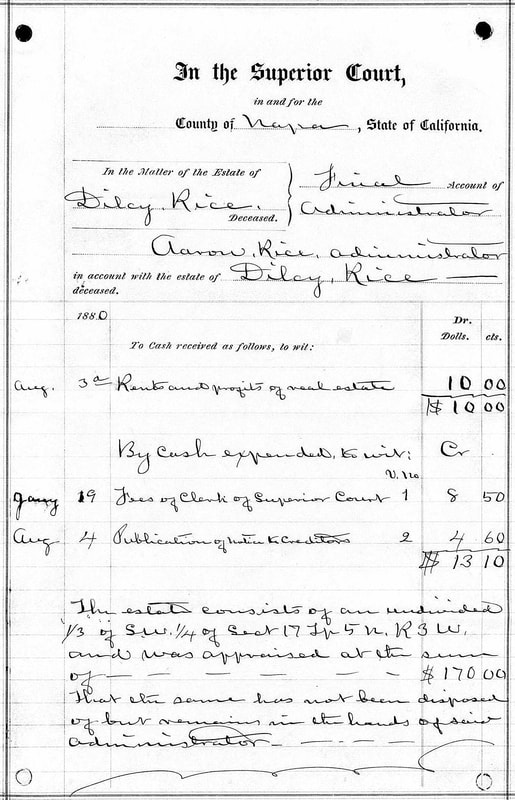 Aaron's Final Account, Augest 4, 1880 Aaron's Final Account, Augest 4, 1880 On February 6, the estate’s appraisal listed only the land valued at $170. Following instructions, Aaron published a notice from February 7 through March 6 in the Napa Register, which they confirmed on March 30. The “Proof of Publication and Notice to Creditors” filed April 12 was followed by the decree, “Due and Legal Notice to Creditors has been Given”, on July 15 and a final accounting on Aug 2, which listed simply: Cash Received $10 from Rents; Cash Expenditures - Clerk Fees $8.50, Publication Fees $4.60, totaling $13.10; Estate appraisal $170 ($3,761.21 today). Including the $100 bond and the $10 clerk fees for registering the sale of the farm to Lucas, Aaron spent a total of $123.10 ($2,723.56 today) not including his attorney fees. On August 4 an “Affidavit to Forgoing Account” (in which Aaron stipulates that there are no other debts and all accounts have been settled) followed by the “Petition for Distribution of Estate” are filed. Again he states he is 58 and Dilcy’s only child. He further stipulates that the estate is ready to be closed. An “Order appointing day for Settlement of Account and Directing Notice to be Given” is issued for Tuesday August 17, at 10 am. The notice was immediately posted by Henry Brown at the Wells Fargo Co. & Express offices, the Courtroom and outside the Courthouse and sworn to on August 9. After a “Final Decree of Settlement of Final Account by Administrator” is filed reiterating everything that has transpired prior, the “Decree of Distribution of Estate” is finally issued at the distribution hearing on August 17. Within the document it states, “…And that the said Dilcy Rice died in testate, leaving him surviving Aaron Rice son of deceased aged 60 years, residing in Napa County California, William Rice, son of deceased aged 62 years and Judy Schlesher, daughter of deceased aged 58 years (residence of last named son and daughter unknown) who are entitled to the residue of said estate.” 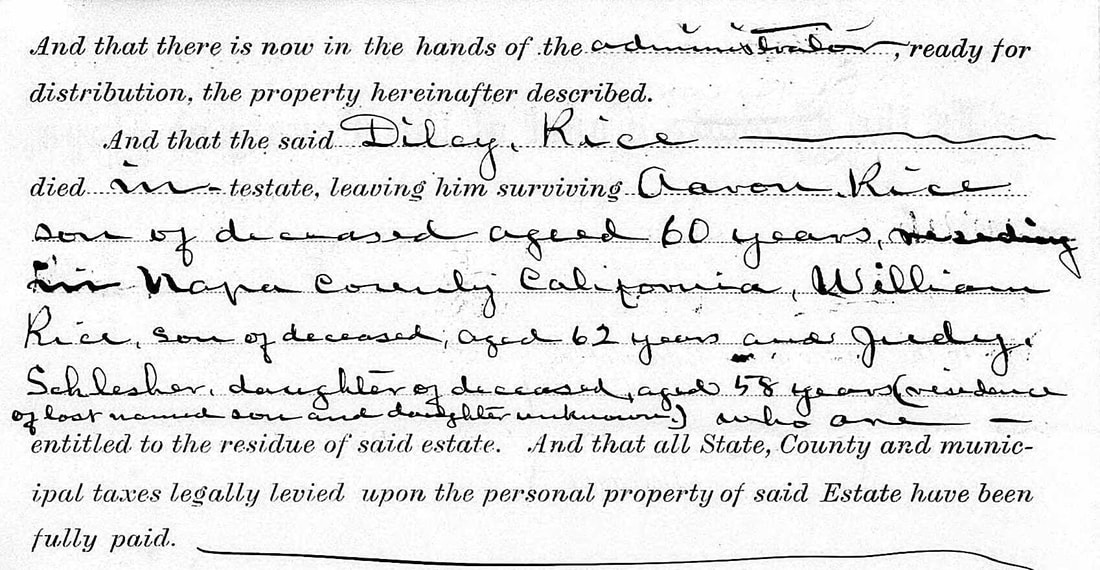 Dilcey Estate's Final Distribution Order, August 17, 1880 The authors of this column were stunned to say the least. Was this William Rice, slave owner of Aaron and his family claiming at the last minute he was the son of Dilcy? Was he still holding a grudge? And, who was Judy Schlesher? Upon further research we discovered that Aaron indeed had siblings after all. Judge Wallace’s final distribution order of Dilcy’s estate issued each a third or effectively a ninth of the entire family farm. Since Aaron had already sold his interest to Manual Lucas, that only left William’s and Judy’s portion unsold. More on his Aaron’s siblings and Nathaniel next as we continue Aaron’s story. 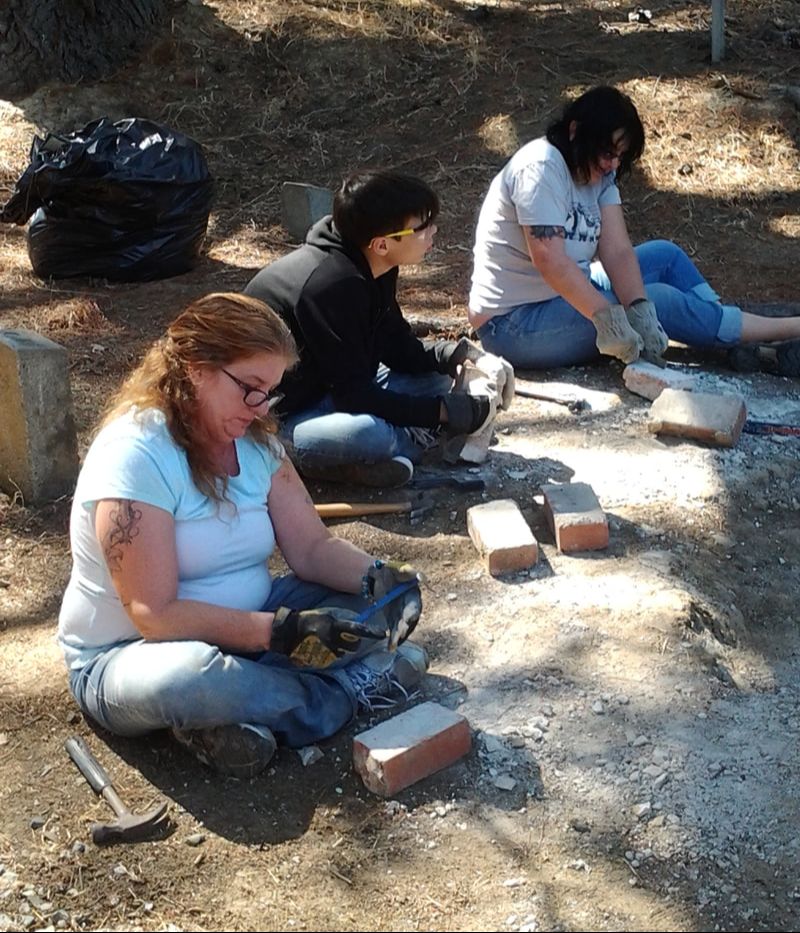 Lisa Adkisson, Matthew White, Bili White Lisa Adkisson, Matthew White, Bili White Saturday, May 12 is the first Alhambra Cemetery Cleanup Day and our first Potter’s Field Restoration Project workday of the year sponsored by the City of Martinez and E. Clampus Vitas. The hours are 9am to 2pm, with E. Clampus Vitas providing lunch and SOLS providing refreshments. While there is plenty of work to do to maintain, preserve, and restore this very important outdoor museum, as the story goes, “many hands make light work”. Come join us and be a part of our ever growing volunteer community as a good time is had by all! Lastly and for good measure it’s a chance to visit the site and inspiration behind our columns.
For more information, or to volunteer with the Potter’s Field Restoration Project, please visit our website. Do you have a Potter’s Field resident story to tell? We welcome any pictures or information on anyone or anything regarding Potter’s Field. Please email us at martinezcemetery@gmail.com or call us at (925) 316-6069. This article was published in the Martinez News-Gazette on 04/22/2018 and is the twelfth part of our continuing story about Aaron Rice and his family.Our last installment found on November 14, 1872, the Rice family grew when Aaron’s 26-year-old son Nathaniel married 18-year-old Rebecca Donzel with no family members present. Also mentioned in an announcement regarding churches on March 18, 1871 published in the Napa County Recorder, Rev. Robert Rice (Aaron’s father) gave two sermons a day as acting minister for the Napa AME Church, while Nathaniel supervised the Sunday School. Robert also owned the family farm that employed both Aaron and Nathaniel. 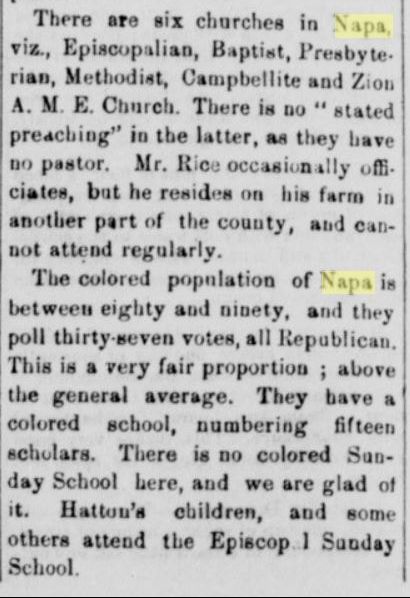 Elevator, 1 November 1873, Courtesy Public Domain Elevator, 1 November 1873, Courtesy Public Domain On Nov. 23, 1873, Elevator newspaper representatives from San Francisco visited Napa to report on its African-American community, and then published their findings on Nov. 30, 1873. An excerpt, “… There are six churches in Napa, viz., Episcopalian, Baptist, Presbyterian, Methodist, Campbellite, and Zion A. M. E. Church. There is no “stated preaching” in the latter, as they have no preacher. Mr. Rice occasionally officiates, but he resides on his farm in another part of the county, and cannot attend regularly. “The colored population of Napa is between eighty and ninety, and they pole thirty-seven votes, all Republican. This is a fair proportion; above the general average. They have a colored school, numbering fifteen scholars. There is no colored Sunday School here, and we are glad of it. Hatton’s children, and some others attend the Episcopal Sunday School. …” It should be noted that the Elevator believed in total integration of African-Americans in all aspects of society including education which help explains their comment. The Pacific Appeal, their rival, believed in the creation of an independent African-American community. 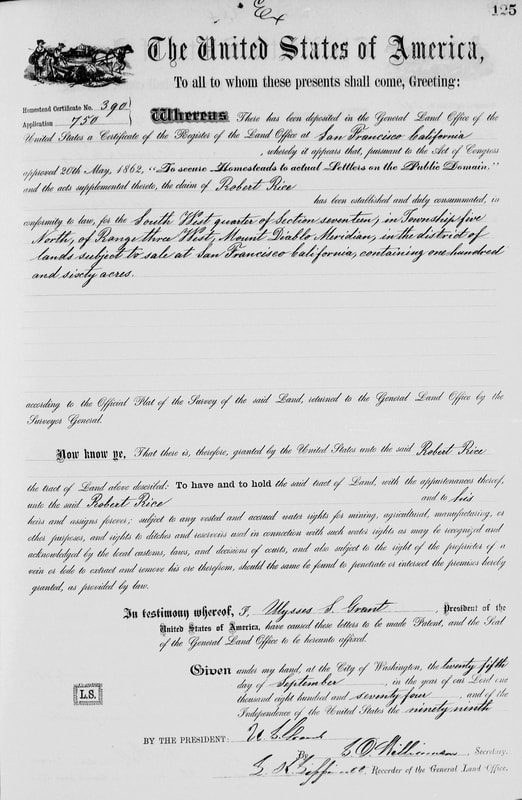 Robert Rice US Land Patent, Courtesy Public Domain Robert Rice US Land Patent, Courtesy Public Domain In the meantime, some important points are raised regarding the Rice family. Rev. Rice in 1871 is regularly conducting two services, while Nathaniel oversees the Sunday School every Sunday. Two years later, he is unable to and the school is gone despite the Napa County’s African-American population having grown from 43 in 1862 to 80-90 in Napa City alone by 1873. By September 25, 1874, the terms of Robert’s May 20, 1862 Homestead Application are fulfilled allowing for the free and clear ownership of the family farm. There is no mention of Charlotte (Aaron’s wife) with whom he purchased the property in 1860 due to married women’s land ownership not being federally recognized. Additionally we found an April 24, 1869 deed stating Robert sells 2/3 of the farm to Aaron for $1. Most likely, this was for Charlotte’s portion of the property. 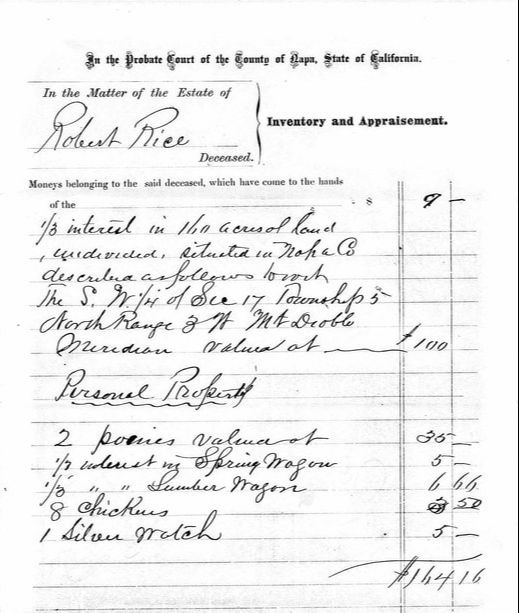 Robert Rice Probate Appraisal, Courtesy Public Domain Robert Rice Probate Appraisal, Courtesy Public Domain On March 20, 1875, tragedy begins to befall the Rice family as 75 year old Rev. Robert Rice dies from dropsy (edema caused by heart congestion today). His estate consisted of, cash & coin - $9, 1/3 of the family farm - $100, 2 ponies - $35, 1/3 interest in spring wagon - $5, 1/3 interest in lumber wagon - $6.66, 8 chickens - $3.50, silver watch - $5, for a total worth of $164.16 or $3,606.35 today. His probate was settled on May 24, 1875 awarding it all to his widow Dilcy after she paid $100 bond, court costs and unknown attorney fees. Later that year on November 1, Rebecca dies at 21, childless. In researching her death, we made an interesting discovery. Although only her name and age were listed within Napa County records, we were able to find cause of death and more contained within the Tulocay Cemetery’s records. Not only did we learn she died of consumption (tuberculosis today) but that she was also determined to be “Copper” a term used for anyone of Asian descent. This might explain why their wedding had no family present. Then on February 16, 1876, Dilcy age 84 dies of “old age”, followed less than a month later by Charlotte age 64 on March 3, from typhoid fever, a very contagious disease known to thrive in unsanitary conditions regarding water and raw food. Napa County at this time did not have a reliable clean water system and a number of the farmland wells were susceptible to contamination from the bacteria. The close proximity of their deaths makes it highly suspicious and most likely that Dilcy also died of Typhoid, as the elderly and the young were the most vulnerable.  County Section of Tulocay Cemetery, Napa CA, where Aaron's Family is buried in unmarked graves. All four deaths happened in less than a year, decimating a once strong thriving family unit. We can only imagine the devastating grief Nathaniel and Aaron must have suffered. However, they pressed on and a year and a half later there is joy again.  Marriage Certificate for Annie Elizabeth Dyer and Nathaniel Rice, Courtesy Marriage Certificate for Annie Elizabeth Dyer and Nathaniel Rice, Courtesy On October 31, 1877, Nathaniel age 31 marries again when he weds Edward Hatton’s stepdaughter Annie Elizabeth Dyer age 27. Their witnesses were her stepbrother Joseph Hatton and Fred Sparrow (the first Napain African-American to register to vote) and was officiated by the prominent Rev. Richard Wylie, pastor of the Napa Presbyterian Church. You will recall from our earlier writings that the Hatton’s were the prominent face of the Napian African-American community. Annie and Nathaniel’s wedding therefore is proof of how close the two families were and the prominence the Rice’s must have held. (Interesting side note on their marriage certificate it makes a point to mention that “neither party married before.”) Coming up in the next part of the story, we will be exploring Dilcy’s probate which wasn’t filed until 1880. There are yet more exciting revelations to be divulged in our next column. 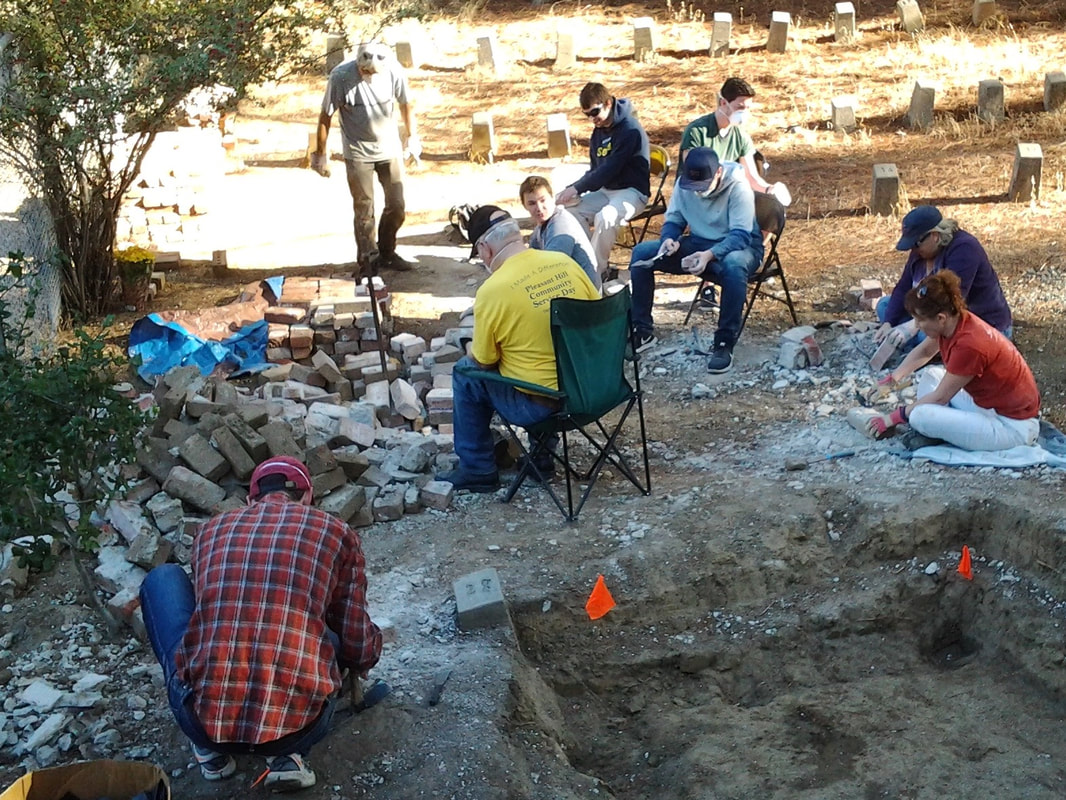 L to R Christopher Lowman, Dan Mosier, John Burgh, Crowley Brynn, Kevin Crane, Kyle Rainey, Devon Knight, Carolyn Knight, Shauna Mudnt, Courtesy L to R Christopher Lowman, Dan Mosier, John Burgh, Crowley Brynn, Kevin Crane, Kyle Rainey, Devon Knight, Carolyn Knight, Shauna Mudnt, Courtesy Coming up on Saturday, May 12 is the first Alhambra Cemetery Cleanup Day and our first Potter’s Field Restoration Project workday of the year sponsored by the City of Martinez and E. Clampus Vitas. The hours are 9am to 2pm, with E. Clampus Vitas providing lunch and SOLS providing refreshments. While there is plenty of work to do to maintain, preserve, and restore this very important outdoor museum, as the story goes, “many hands make light work”. Come join us and be a part of our ever growing volunteer community as a good time is had by all! Lastly and for good measure it’s a chance to visit the site and inspiration behind our columns.
Judie & Joseph Palmer are two of the founding members of the Martinez Cemetery Preservation Alliance (MCPA) and the Potter’s Field Project. Both have a passion for discovery, history, genealogy, anthropology and archaeology. For more info, please visit our website MartinezCemetery.org. Do you have a Potter’s Field story to tell? We welcome any pictures or information regarding the Alhambra Pioneer Cemetery or its Potter’s Field. Please email us at martinezcemetery@gmail.com or call us at (925) 316-6069. This article was published in the Martinez News-Gazette on 04/8/2018 and is the eleventh part of our continuing story about Aaron Rice and his family.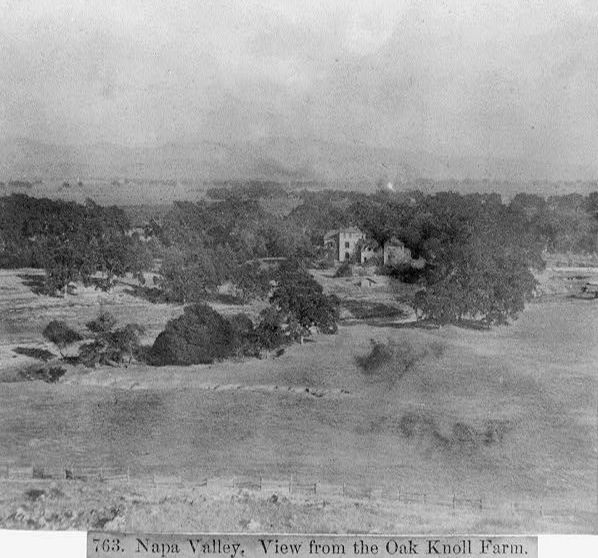 To recap Aaron Rice and his family’s story since they gained their freedom, we created a list of the important events we have covered to date. We started with their first Holidays as free people in 1860, the loss of their son Lewis in 1862, the Civil War from 1861 – 1865, their founding of the Napa AME Church in 1867, and finally the ratification of the 14th and 15th Amendments to the US Constitution giving them full citizenship in 1870. In this iteration, we highlight their relative peace, prosperity and happiness from 1860 – 1873 with additionally discovered information and events. Despite all of them living through enslavement and the dysfunction of William Rice, there was some positives to come out of their trauma. First, they had miraculously remained intact as a family, an uncommon occurrence for former African-American Slaves. Second, they had each gained valuable skills from their forced labor. Both of these factors allowed them to not only survive but also thrive in their new home in Napa, California. 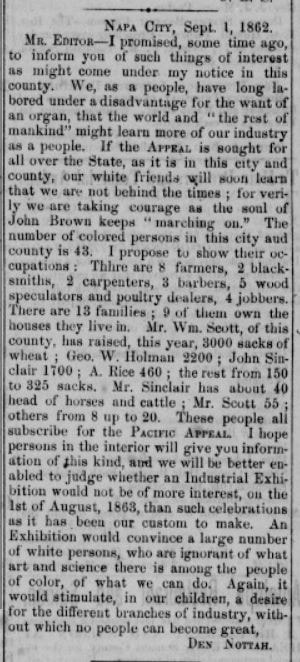 Letter to the Editor from Den Nottah, Pacific Appeal, 6 September 1862, Courtesy Public Domain Letter to the Editor from Den Nottah, Pacific Appeal, 6 September 1862, Courtesy Public Domain The United States Census 1860 Agricultural Schedule 3 shows the previous owner of their 160-acre farm, William Russell (also African-American) did not fulfill the requirements of the Homestead Act by making the necessary improvements. Therefor William sold the property in foreclosure for $100 to Robert and Charlotte. In order not to lose the land themselves, the Rice family had to cultivate crops, and within a couple years build a dwelling. From a letter to the editor of the Pacific Appeal dated Sep 1, 1862, Den Nottah gives a peak into the Rice’s community. He states, “The number of colored persons in this city and county is 43. I propose to show their occupations: There are 8 farmers, 2 blacksmiths, 2 carpenters, 3 barbers, 5 wood speculators and poultry dealers, 4 jobbers. There are 13 families; 9 of whom own the houses they live in. Mr. Wm. Scott of this county, has raised, this year 3000 sacks of wheat; Geo. W. Holman 2200; John Sinclair 1700; A. Rice 460; the rest from 150 to 325 sacks. Mr. Sinclair has about 40 head of horses and cattle; Mr. Scott 55; others from 8 up to 20.” Aaron and Nathaniel would have done most of the wheat harvesting and preparation for its milling. On a good day, they would have used their horse drawn wagon to travel the dirt roads back into town hauling Robert’s grain. They potentially left it with W. R. Cooper’s Flour Mill on the corner of Water and McKinstry. As they turned on to Main Street, they might have dropped in J. B. Murphy’s Candy Factory and Bakery (86 Main St.) and visited their friend, Joseph Hatton at his barber shop (128 Main St). They might also have visited Beebe & Hall (126 & 129 Main St.) or D. B. Parks Harness and Saddles, established in 1852 (120 Main St.) for horse equipment repairs. 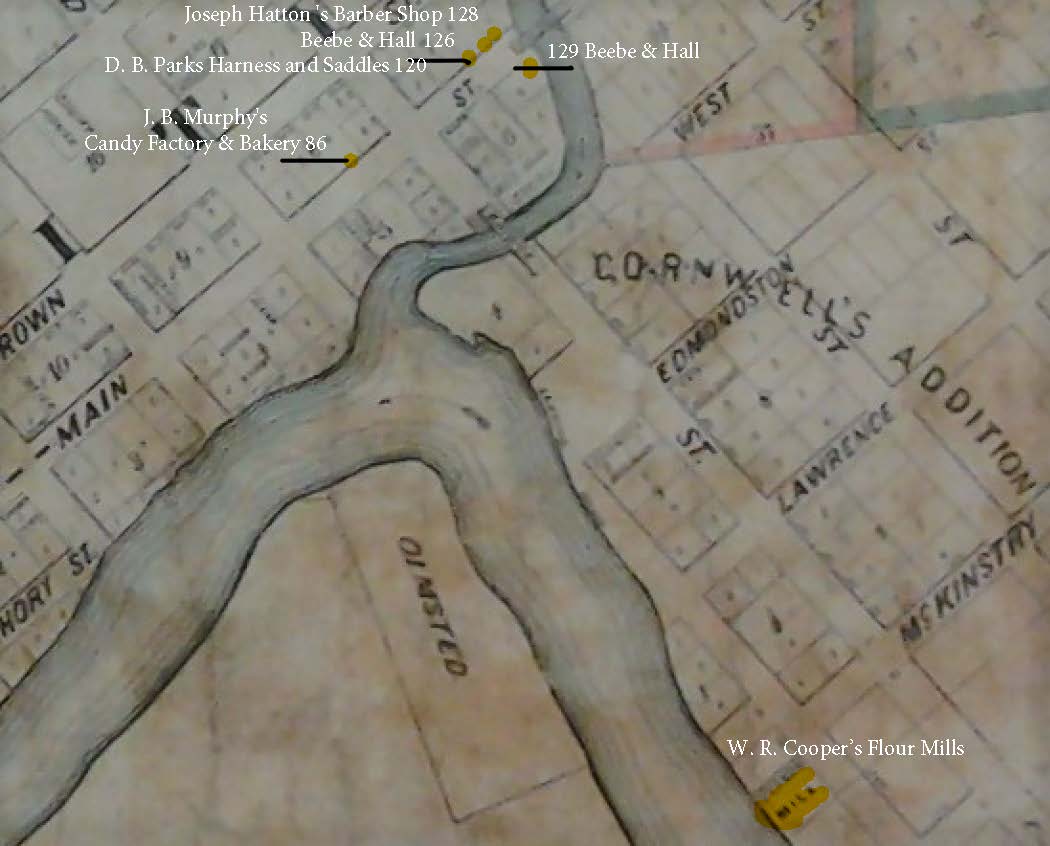 1869 Napa Map, Courtesy Public Domain Along the way they would have viewed the Amelia (1860-1870), a 174-foot steamboat, dock in Napa, delivering the San Francisco Elevator and Pacific Appeal newspapers, dropping off and picking up passengers, local grown products and other goods. Additionally they would observe the Napa Valley Railroad (1864-1869), the first train to run through Napa, bringing additional visitors, settlers, news, and profits, which also increased Robert’s property value.  1871 Napa Birds Eye View, Courtesy Public Domain Once enough time had passed, they would return back to the mill for their flour, which they then sold locally, to exporters, or kept for personal use. From which Charlotte and Dilcy would then create baked goods for themselves and for sale at market. Examining US Census data can tell you a lot about an individual and their family. From the United States Census, 1870 it lists the Rice’s under “Dwelling-house” number 576. From the Ninth Census, 1870 Instructions to Assistant Marshalls, a dwelling house meant, “a house standing alone or separated by walls from other houses in a block.” 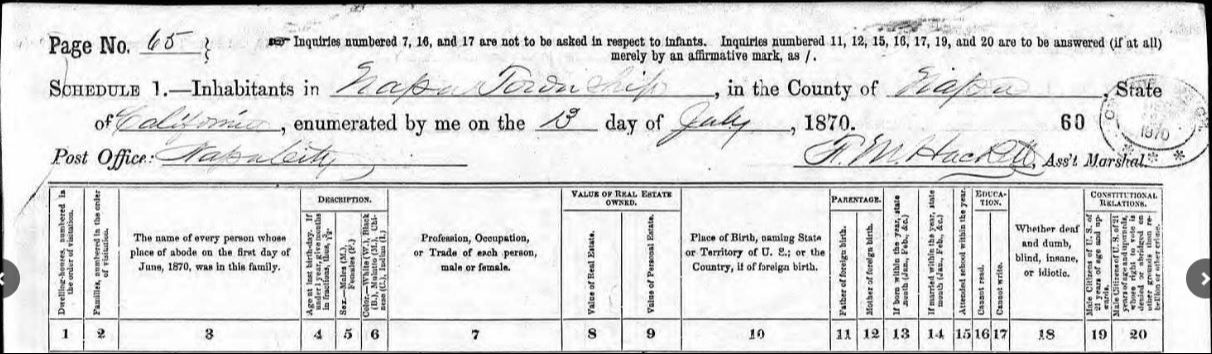 1870 US Census, Rice Family, Top of Form Their “Family Number” is 532, which means all individuals listed under No. 532 live together as family. The first “Head of Household”, shows Robert, Aaron’s father, aged 70, followed by Dilcy aged 74, Aaron aged 49, Nathaniel aged 24, and Charlotte aged 58. Under occupation, Robert is a “farmer”, defined as someone who owns farmland. Dilcy as “keeping house”, defined as a woman, “keeping house for their own families or themselves without any other gainful occupation.” Aaron and Nathaniel are “laborers”, defined as employees, thereby meaning they were employees of Robert. Charlotte has “no occupation.” 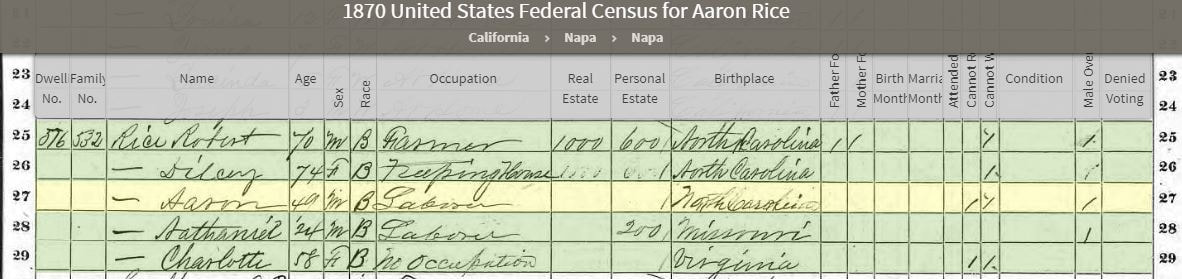 1870 US Census - Rice Family The next two columns lists property and personal estate value. In the Ninth Census manual, it states, “…farms for the purposes of the Agricultural Schedule include all considerable nurseries, orchards, and market gardens which are owned by separate parties which are cultivated for pecuniary profit, and employ as much as the labor of one able-bodied workman during the year. …no farm will be reported of less than 3 acres, unless five hundred dollars’ worth of produce has actually been sold off from it during the year.” Robert’s column lists his property value at $1,000 ($17,000 today) and his personal estate (furniture, vehicles etc.) at $600 ($9,000 today). Since, Aaron’s columns are left blank we can assume he didn’t own anything. However, Nathaniel has a personal estate of $200 ($3,000 today). Perhaps he owned a cow?  1870 US Census - Rice Family, Bottom of Form Their births are listed as follows, Robert, Dilcy and Aaron in North Carolina, Charlotte in Virginia and Nathaniel in Missouri. Additionally only Robert’s parents are listed as foreign born, which means they were brought here on slave ships. The Census also asked about literacy. Aaron and Charlotte were never taught, Robert and Dilcy could read somewhat but not write, while Nathaniel had the opportunity to learn both. Last note, it is also the first Census listing Robert, Aaron and Nathaniel as United States Citizens.  Front of AME Church Today. Front of AME Church Today. From the March 18, 1871 Napa County Reporter, listing all places of worship was an announcement that read, "African Methodist Church, Washington St. — Rev. Robert Rice. Preaching every Sunday at 11 o'clock a.m., and 7 1/2 p.m. Sunday School at 2 1/2 o'clock p.m., Nathaniel Rice, Superintendent." As a family, they would leave their farmhouse together on Sunday mornings and head to their church to fulfill their spiritual obligations. 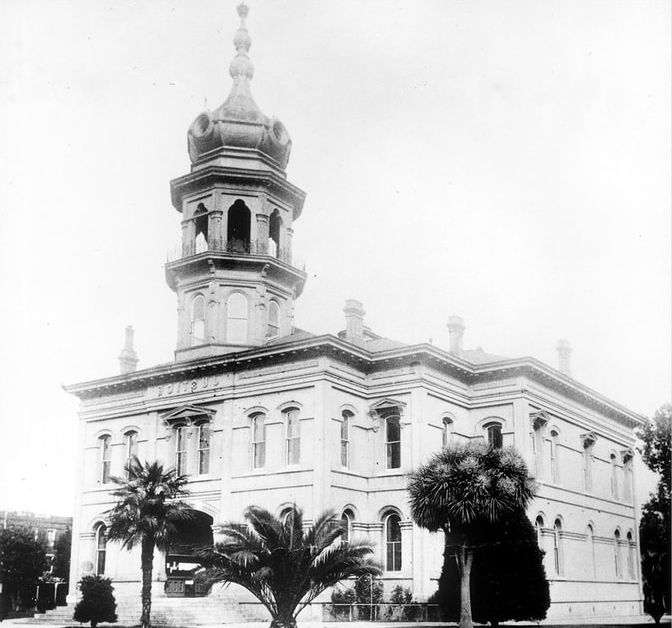 Napa County Courthouse 1879, Courtesy Public Domain Napa County Courthouse 1879, Courtesy Public Domain On November 14, 1872, the Rice’s gained another member as Nathaniel married Rebecca Donzel. They applied for a marriage license that day at the Napa County Court House and not waiting to get married were joined in matrimony by the Rev. G. W. Ford a Baptist Minister. He was on hand to perform their wedding with the County Clerk acting as the witness. This raises the question, why were no family members present? Perhaps they were fearful their families would object? Their wedding announcement appeared in the Elevator on November 23, 1872. It stated, “Married! In Napa City November 14, by Rev. G. W. Ford, Rev. Nathaniel Rice and Miss Rebecca Danzel.” In 1872, their marriage was the 311 registered in Napa County. 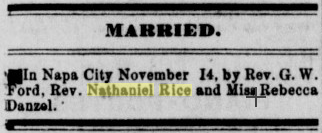 The Elevator, 23 November 1872, Marriage Announcement, Courtesy Public Domain Judie & Joseph Palmer are two of the founding members of the Martinez Cemetery Preservation Alliance (MCPA) and the Potter’s Field Project. Both have a passion for discovery, history, genealogy, anthropology and archaeology. For more info, please visit our website MartinezCemetery.org. Do you have a Potter’s Field story to tell? We welcome any pictures or information regarding the Alhambra Pioneer Cemetery or its Potter’s Field. Please email us at martinezcemetery@gmail.com or call us at (925) 316-6069.
This article was published in the Martinez News- Gazette on 03/25/2018 and is the tenth part of our continuing story about Aaron Rice and his family.Picking up where we left off with Aaron Rice’s story, we had discussed how he and his family along with others had founded the African Methodist Episcopal Church. Not only did it serve as a place for worship, but it also served as their community center to congregate and discuss the political and community issues and events of the day. 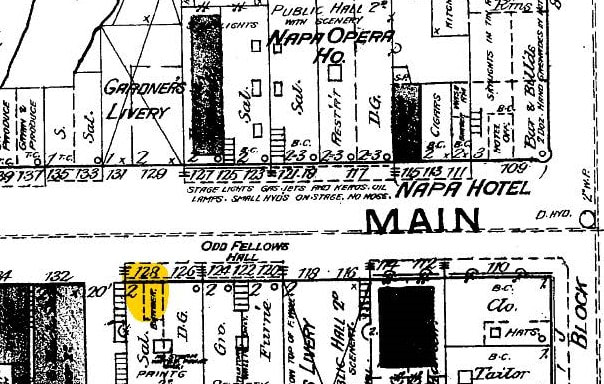 Joseph Hatton's Barbershop, 1886 Sanborn Map, Courtesy Public Domain However, this was not the only location available to them for socializing and exchanging information. Joseph Hatton’s Barber Shop, located at 126 Main Street, Napa across from the Napa Opera House also served as a hub of the African-American community. Their barber shop sat alongside the Napa Creek which fed into the Napa River, where steamers stopped and delivered newspapers at the wharf. As mentioned before, both Joseph and his father, Edward, were field agents for the African-American San Francisco newspapers, the Pacific Appeal and the Elevator. 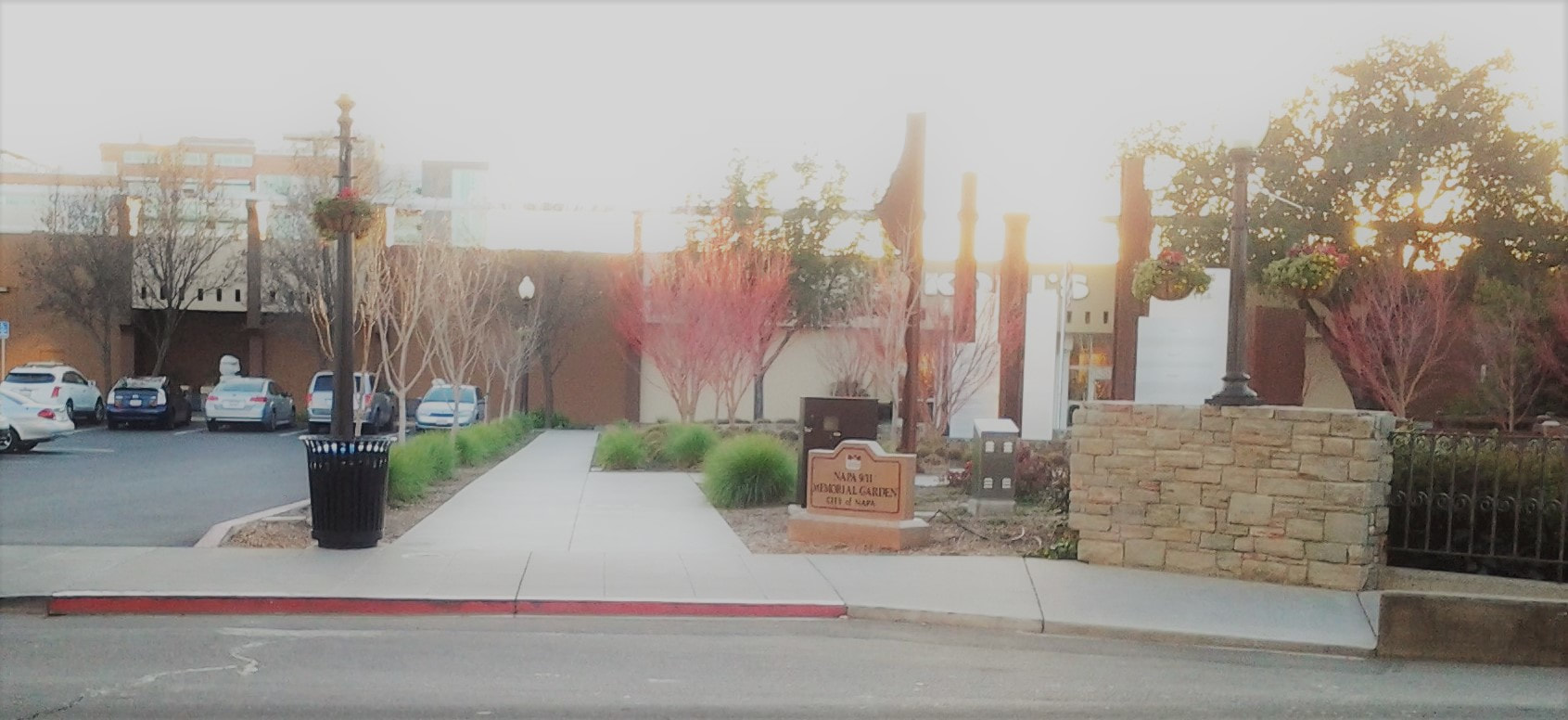 Joseph Hatton's Barbershop Location Today In Eunsun Celeste Han’s dissertation, All Roads Lead To San Francisco: Black Californian Networks of Community and the Struggle for Equality 1849-1877, he writes “Aside from carrying letters, parcels, and people, the steamers helped circulate one of the most crucial mediums of nineteenth century community building: Newspapers. Newspapers at this time were more than just daily or weekly pages of recent news. They were the great bulletin board for the public, and if they were the organ of one specific group of people, then they also served as the primary contributor to defining, expanding, and sustaining the boundaries of that community. Black Californians learned of every upcoming event, newly opened black business, Sunday schedules of black churches in various different cities, the prominent political issues of the day, and the birth, death, weddings, and injuries of black people up and down the Pacific Coast.”  When the news arrived that the Fifteenth Amendment had been ratified on February 5, 1870, Aaron and his community celebrated. On March 30, 1870, Phillip Bell wrote in his newspaper, the Elevator, “PROGRESS OF LIBERTY! Gloria triumphe! We are free! The Fifteenth Amendment which confers upon us full rights of citizenship has received the ratification of the requisite number of States.” However, the road to passage and therefor implementation of the Fifteenth Amendment in California was not an easy one. 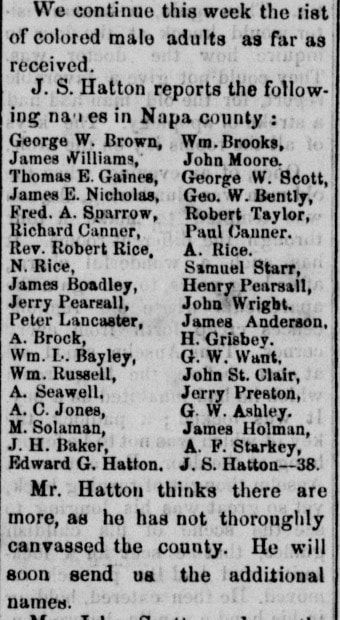 Elevator November 26, 1869, Courtesy Public Domain Elevator November 26, 1869, Courtesy Public Domain In Stacy Smith’s March 5, 2014 article, California’s Last Slave Case, she states, “In 1867, a revived California Democratic Party pledged to stall the extension of voting rights to black men. Democrats argued that giving the vote to one nonwhite group would inevitably lead to the enfranchisement of Chinese immigrants.” Californian Democrats were really concerned about the invasion of Chinese immigrants, who outnumbered African-Americans in California by a ten-to-one ratio. Stacy Smith continues, “The Democratic promise of “no Negro or Chinese suffrage” appealed to members of California’s growing anti-Chinese movement, and they swept the state elections. Over the next three years, the Democratic legislature refused to ratify the 14th Amendment, which would guarantee African-American civil rights, and rejected the 15th Amendment, which would give voting rights to black men.” In an effort to put pressure on the California Legislature to ratify the amendment, both the Elevator and the Pacific Appeal sponsored efforts to preregister African-Americans throughout the state to vote. In the November 26, 1869, Number 34 issue of The Elevator, a section reads, “Joseph Hatton, a black barber in Napa, California, issues a list of the prospective voters in his area.” Aaron along with his son Nathaniel Rice, his father Rev. Robert Rice and 35 other members of the Napian African-American community eagerly went to Joseph Hatton’s Barbershop to become a member of that list. 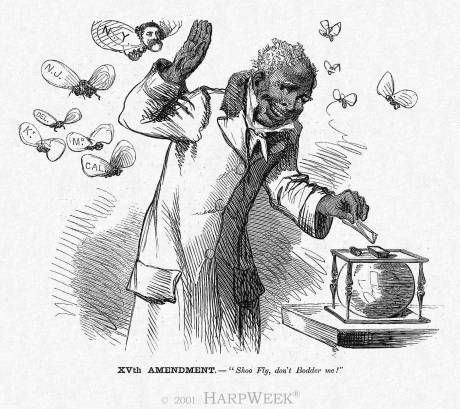 Harper's Weekly March 12, 1870, Courtesy Public Domain Harper's Weekly March 12, 1870, Courtesy Public Domain From a March 12, 1870 Harper’s Weekly illustration, California is depicted along with the states of NJ, NY, KY, MO & DE as nothing more than “flies” trying to bother a happy African-American as he casts his vote. Voting was taken very seriously by the community as this was a right they had long fought for. As the cartoon portrays, they just “shooed” the California fly away to finally be recognized as full-fledged citizens of the United States. The Napa County Reporter recorded the events of April 11, 1870 in detail with the unfortunate racist slant reflected by the previously mentioned Democrats, “At about noon a couple of anvils were brought into requisition, and made to play the part of a cannon. At or near 1 o’clock in the afternoon the exercises of the day commenced in Hartson’s Hall. Prayer was offered up to the Most High, and was followed by singing. Fred Sparrow acted as President of the day and Joseph Hatton as Vice President. Thomas Gains read the 13th, 14th, and 15th Constitutional Amendments. Music. 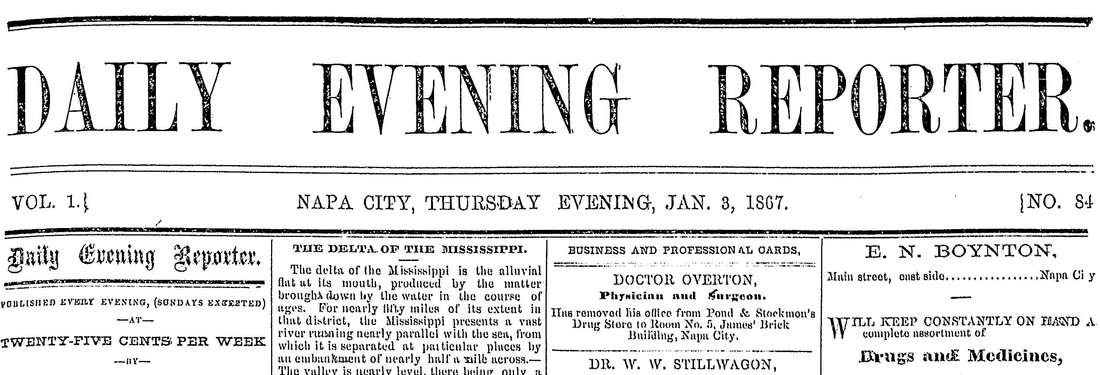 The Napa County Reporter, 1867 Courtesy Public Domain Then came the oration by Mr. Hillery of San Francisco – a genuine but pretty smart darkey. Hillery is a good speaker, and as he was speaking in behalf of his own race his remarks brought forth the most enthusiastic applause from his colored countryman. Like most darkies Hillery has a full appreciation of the humorous, and besides is something of a wag himself; consequently he kept quite a crowd in a good humor for some time. We will not refer particularly to his remarks, but [unreadable] say his reflections upon foreigners was entirely out of place, more particularly as there were a number present. If the negro expects to be a good citizen he must not allow prejudice to get the better of him. The festivities of the day passed off agreeably to the colored people, and nothing occurred to mar or interfere with their jollification. In the evening they set a collision in Quinn & Williams Hall, and sang, marched around the room and enjoyed themselves until near midnight.” 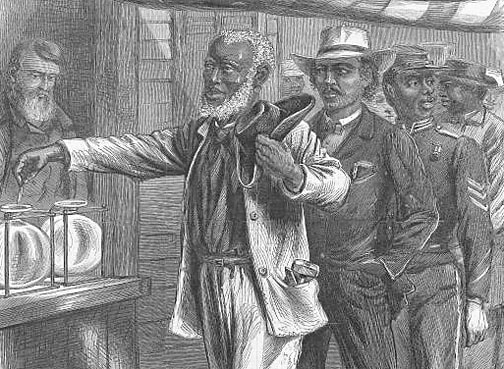 The First Vote, Courtesy Public Domain The First Vote, Courtesy Public Domain Shortly after, voting registration began in Napa with Frederick Sparrow, a 27-year-old barber in Napa City, as the first to register at the County Court House. Aaron and his family followed shortly thereafter as they took their rights as citizens and the ability to vote very seriously. From the 1875 Great Register of Napa County, CA, Aaron first registered to vote on April 16, 1870. He is listed as 49, born in NC and a Farmer with registration #2601 and voting #2081. From the 1880 Great Register of Napa County, CA, on Oct 3, he is now listed as age 59, still a farmer with registration #1983 and voting #2578. Aaron voted religiously and never missed an opportunity to do so before he died at the age of 87.
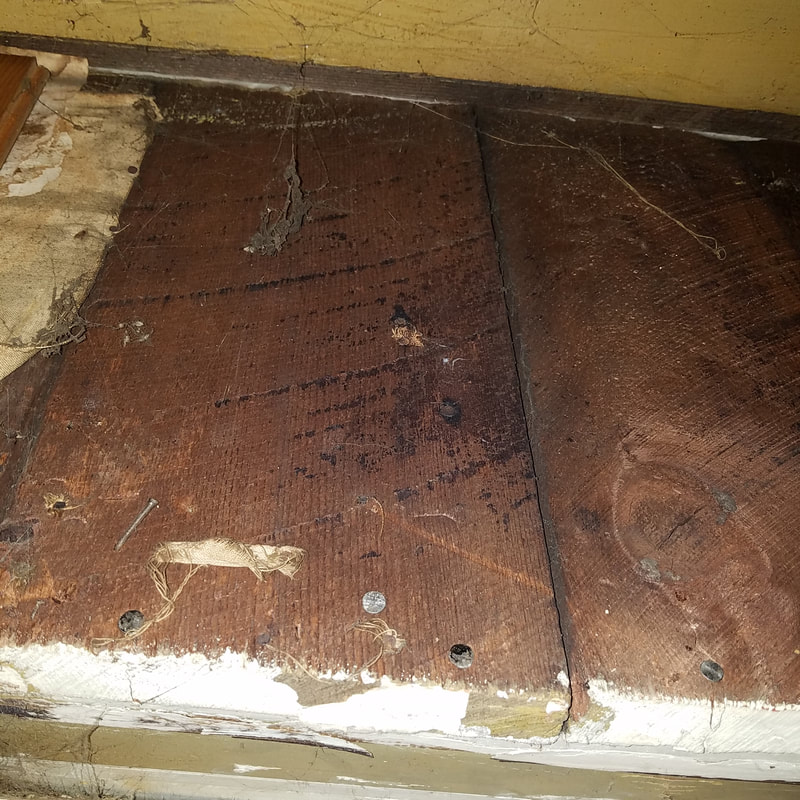
As a side note, it took the civil rights movement of the 1950s and 1960s before California finally ratified the Fourteenth Amendment in 1959 and the Fifteenth Amendment in 1969. For more information, or to get volunteer with the Martinez Historical Society’s - Potter’s Field Restoration Project, please visit our website MartinezCemetery.org. Do you have a Potter’s Field resident story to tell? We welcome any pictures or information on anyone or anything regarding Potter’s Field. Please email us at martinezcemetery@gmail.com or call us at (925) 335-9396. The Martinez Historical Society is recognizing Women's History Month 2018 during the month of March at the Martinez Museum with a wonderful exhibit titled "Celebrating the Women of Martinez", created and curated by Mary Goodman. The exhibit will remain on display through March 29, 2018 during regular museum hours and for specially scheduled tours. Martinez Museum – 1005 Escobar Street, and corner of Court Street. Open Tues and Thurs 11:30 a.m. to 3p.m. First 4 Sundays 1-4 p.m. 925-228-8160; www.martinezhistory.org. Contra Costa County History Center – 610 Main Street, Martinez. Open Tues through Thurs, 9 a.m. to 4 p.m.; 3rd Saturdays, 10 a.m. to 2 p.m. 925-229-1042; www.cocohistory.com This article was published in the Martinez News-Gazette on 03/11/2018. Front of Church circa 1857. Not original window frames. We would like to thank all of you for taking this multipart journey of exploring the life of Aaron Rice and his family during the mid to late 1800’s period of California. This column’s offering is about our latest research trip to Napa, where we made some amazing discoveries that we are excited to share with you. From our last article, we talked about the importance of the African Methodist Episcopal Church of Napa (AME) from 1867 – 1892, and wanting to definitively find the place where it last stood. To our great surprise and excitement, not only did we find the AME Church’s location but amazingly that the building is still standing. This makes it potentially the second oldest known wooden structure built circa 1857 in all of Napa and fourth oldest after the two adobes.  Church Structure Illustrated on Corner, Sanborn Map of Napa, 1891 Courtesy Public Domain. Church Structure Illustrated on Corner, Sanborn Map of Napa, 1891 Courtesy Public Domain. Here’s what we have uncovered so far. From the History of Napa and Lake Counties California, Slocum, Bowen, & Co. Publishers, 1881 it states, “In 1857… During that year Mr. Corwin built a saw-mill on what was then known as the Kellogg ranch, hauled his lumber to town and built the first Methodist church-house in Napa City, which was dedicated in June 1858. …In 1864 …the parsonage caught fire from an adjoining building, and was consumed with its entire contents, including the church records. … The old church house was sold to the colored people and removed to its present position.” From the October 2, 1867 Napa property deed states, “Trustees of the Colored Methodist Episcopal Church” for $250 purchased the, “Northern half of Lot number four (4) in Block number nineteen (19) in the Town of Napa.” In our last column we had mistakenly listed it as “the middle of Oak between Randolph and Franklin streets.” 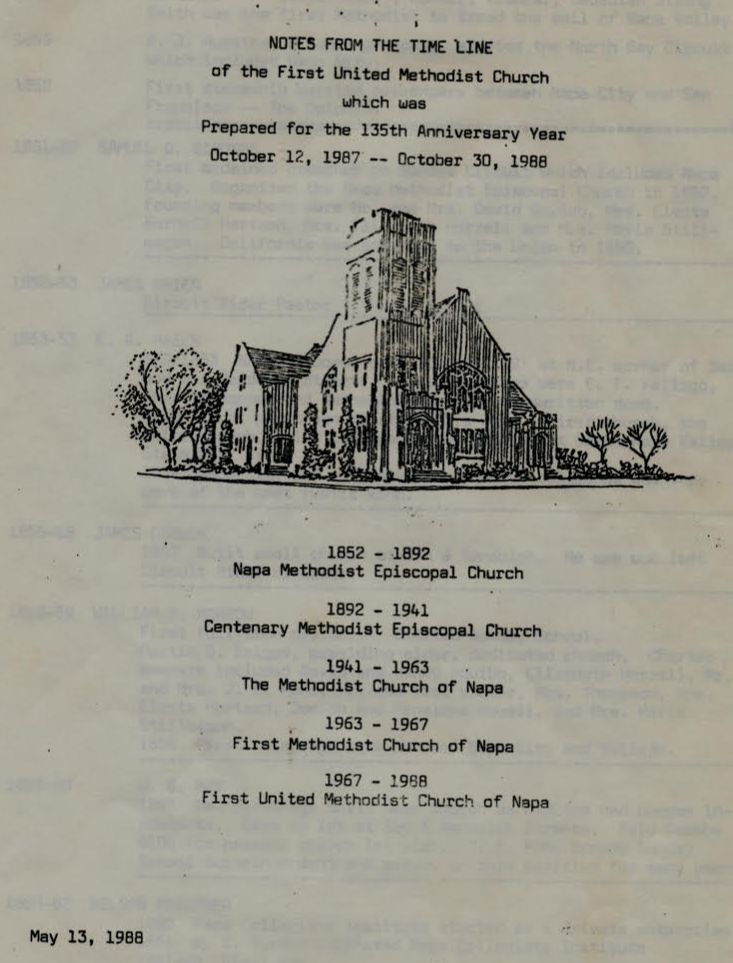 Courtesy Mary Herzog, Historian \ Archivist, Napa Methodist Church Courtesy Mary Herzog, Historian \ Archivist, Napa Methodist Church Again from the article published in the Daily Evening Reporter on May 4, 1867, “Passing by that structure to-day, we found that “our colored brethren” had succeeded in moving it, about twice or thrice its breadth, from its former position.” From Notes From The Time Line, published May 13, 1988, “The first church was moved one block onto Washington Street…” With the aid of Presley Hubschmitt, Research Librarian for the Napa County Historical Society, we agreed it resided near the corner of Oak and Washington Streets facing Washington (Randolph St. today). We know the AME Church existed from 1867 – 1892 but the Sanborn map of Napa 1891, which gives a detailed account of all structures, shows it as an empty lot with a small building at the actual corner of Oak and Randolph Streets. Why would the church trustees purchase an empty lot several months after the building was erected and moved? Perhaps it was for the congregation to park their vehicles and horses.  The diamond shape panes would have originally contained "Church Glass" a single color pane. While the bottom would have been a scene of some sort. The diamond shape panes would have originally contained "Church Glass" a single color pane. While the bottom would have been a scene of some sort. When we visited the site, we spoke with Kenneth Fish the current home owner. He stated that he and his husband have been living in the house since 2000. From their own research, they were told the building had been moved from the present location of the Methodist Church in 1866, but not told it was the former church. He went on to say how rough the house was due to its thin walls, lack of insulation, simplicity of its build, and other oddities that speak to its age. From the Historical Sketch of the Centenary Methodist Episcopal Church 1852-1927 published 1927, parishioner Mrs. Penelope Howell stated, “It was just one room, straight up and down boards with hard benches to sit on. But, we went to be fed with the word of the Lord, so it did not matter how we had to sit, and the one room was big enough for the 12 members of that church.”  Addition added circa 1920's, Lower window not original. Additionally Fish stated it obviously contained only one room, as at some point it was split in two using very thin material. Somewhere along the way lower windows were added using aluminum inner frames within an outer wooden frame that do not match the obvious original top windows near the structures peak. Those frames grain can still be seen from the ground, despite the many layers of paint that has been applied over the years, which is indication that they are made of old growth wood. Finally, an addition was added during the 1920’s. 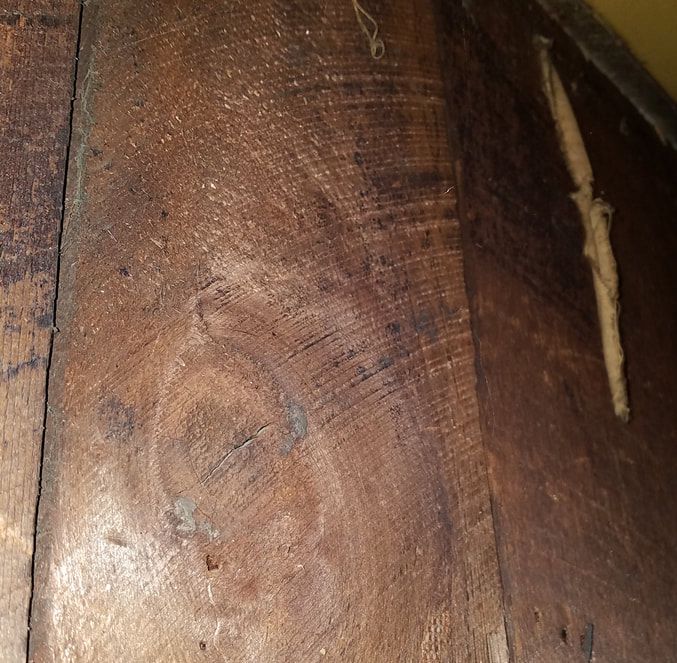 Exterior Wall from Interior, photo courtesy Kennith Fish Exterior Wall from Interior, photo courtesy Kennith Fish Fish also mentioned that it was built out of old growth clear heart redwood, which would help explain how the structure survived. The age of wood is determined by how dense the rings are within its grain. The older the growth, the denser and harder it becomes. Clear heart refers to the deep rich red color caused by the tannins redwood contains. This is important because the tannins are a natural pest repellant. Fish also mentioned the floor is very hard old growth white oak, which has to be kept regularly painted in order to prevent it from splintering.
We then interviewed Mary Herzog, the Napa Methodist Church’s Historian and Archivist. She was just as shocked as we were to discover that the structure had survived all this time while in plain sight. From her records, she sent us copies of the informational timeline and history of the church from its 50th and 75th anniversary’s quoted earlier. From old county tax records she obtained regarding the AME Church it seemed to indicate that when the AME abandoned the building in 1893, that it had been turned into an out building or storage shed. No one expected it too still be standing, let alone converted into a home due its roughness of build. We have contacted various authorities and experts to confirm our findings and believe we have made a pretty strong circumstantial case despite the missing deed for the S half of Lot 4 of Block 19. Stay tuned... The authors of this column would very much like to thank John Tuteur, Lawrence Rodriguez, Alexandria Brown, Presley Hubschmitt, Nancy Levenberg, Mary Herzog, Kenneth Fish, and Stacy Smith for their help with our research. We would not have been able to have made this discovery without their generous support and collaboration. To all of them we offer a huge debt of gratitude and thanks. For more information, or to get volunteer with the Martinez Historical Society’s - Potter’s Field Restoration Project, please visit our website MartinezCemetery.org. Do you have a Potter’s Field resident story to tell? We welcome any pictures or information on anyone or anything regarding Potter’s Field. Please email us at martinezcemetery@gmail.com or call us at (925) 335-9396. The Martinez Historical Society is recognizing Women's History Month 2018 during the month of March at the Martinez Museum with a wonderful exhibit titled "Celebrating the Women of Martinez", created and curated by Mary Goodman from March 4, 2018 through March 29, 2018 during regular museum hours and for specially scheduled tours. Learn about 27 Martinez women who have made interesting and major contributions to the City of Martinez over the years. Photographs and personal items of these amazing women will be on display, along with their fascinating and awe-inspiring stories. Martinez Museum – 1005 Escobar Street, and corner of Court Street. Open Tues and Thurs 11:30 a.m. to 3p.m. First 4 Sundays 1-4 p.m. 925-228-8160; www.martinezhistory.org. Contra Costa County History Center – 610 Main Street, Martinez. Open Tues through Thurs, 9 a.m. to 4 p.m.; 3rd Saturdays, 10 a.m. to 2 p.m. 925-229-1042; www.cocohistory.com |
AuthorsJudie & Joseph Palmer are two of the founding members of the Martinez Cemetery Preservation Alliance (MCPA) and the Potter’s Field Project. Both have a passion for discovery, history, genealogy, anthropology and archaeology. Archives
October 2021
Categories |





 RSS Feed